
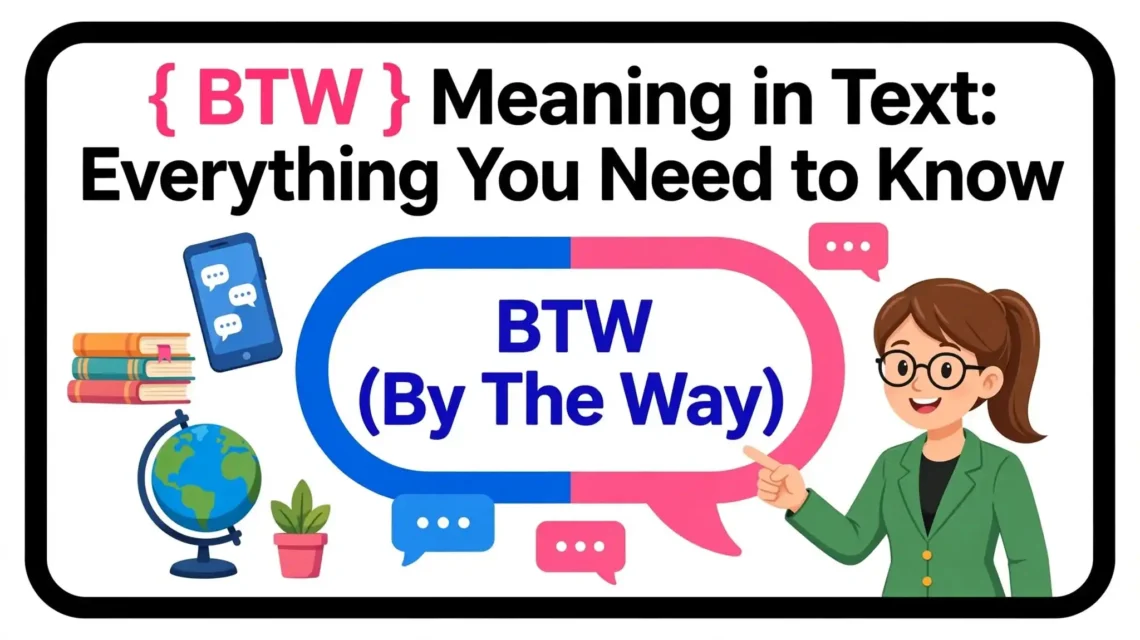
When it comes to texting, short forms help people share ideas quickly without typing full sentences. One of the most common abbreviations is BTW meaning in text, which usually means “by the way.” People use BTW in text messages, chats, social media comments, emails, and online conversations. It can introduce an extra thought, change the subject, add a small detail, or make a message feel casual. In this guide, you will learn what BTW means, how people use it, when it fits, and when a different phrase may work better. You will also see simple examples, common mistakes, similar abbreviations, and examples for different types of conversations.
What Does BTW Mean in Text?
BTW is a common texting abbreviation for “by the way.” It introduces an additional point that may not be directly connected to the main topic.
For example:
“BTW, are you coming tomorrow?”
Here, the speaker adds a new question after discussing something else. The abbreviation keeps the message short and informal.
BTW Meaning in Text Messages
In text messages, BTW often signals a side note or an extra detail.
For example:
“I finished the assignment. BTW, the teacher moved the deadline.”
The first sentence gives the main information. The second sentence adds something related but separate.
BTW can appear at the beginning, middle, or end of a message:
- Beginning: “BTW, I saw your brother today.”
- Middle: “I was, BTW, thinking about your idea.”
- End: “I can bring snacks BTW.”
The first position is the most natural in casual texting.
Why Do People Use BTW?
People use abbreviations such as BTW for several practical reasons:
- They save typing time.
- They make casual chats feel relaxed.
- They fit the informal style of messaging.
- They help introduce side comments.
- They make short messages easier to write.
- They are widely understood by frequent internet and text users.
The exact tone depends on the conversation. BTW can sound friendly, neutral, playful, or slightly abrupt depending on the words around it.
BTW Meaning in Texting and Online Chat
The phrase “by the way” has been part of everyday English for a long time. BTW is simply its shortened digital form.
Online communication created a strong need for quick expressions. Text messages, instant messaging, forums, and social media all encouraged users to shorten common phrases.
Other examples include:
- LOL — laughing out loud
- BRB — be right back
- IDK — I don’t know
- IMO — in my opinion
- TBH — to be honest
- FYI — for your information
- LMK — let me know
BTW belongs to this larger group of internet and texting abbreviations.
BTW in Social Media
People commonly use BTW in comments, captions, direct messages, and replies.
For example:
“BTW, your new profile picture looks great.”
Or:
“BTW, does anyone know when the event starts?”
Social media conversations tend to be informal, so BTW usually feels natural there.
However, context still matters. A professional announcement may sound clearer when the writer uses “by the way” instead of the abbreviation.
BTW in Group Chats
Group chats provide another common setting for BTW.
Imagine a group discussing weekend plans:
“We can meet at 6. BTW, Sarah said she might join us.”
The abbreviation lets the speaker add information without creating a completely separate message.
This can make conversations easier to follow because a person can connect an additional detail to the current discussion.
How to Use BTW Correctly in a Sentence
Using BTW is simple. In most cases, place it before an additional thought.
Here are several common patterns.
Pattern 1: BTW + New Information
“BTW, the store closes at 8.”
The speaker adds useful information that was not part of the original topic.
Pattern 2: BTW + Question
“BTW, did you call Mike?”
This works well when someone remembers a question during a conversation.
Pattern 3: BTW + Reminder
“BTW, don’t forget your keys.”
The abbreviation introduces a reminder or side note.
BTW Meaning in Text: Examples for Different Situations
The meaning remains “by the way,” but the purpose can change with context. It may introduce a question, reminder, update, compliment, or topic change.
Example 1: Casual Conversation
“I’m going to the mall later. BTW, do you need anything?”
The speaker adds a related question.
Example 2: Making Plans
“We can meet at 5. BTW, should we get dinner afterward?”
The second thought extends the original plan.
Example 3: School Conversation
“I finished my homework. BTW, did you understand question 7?”
The writer adds another school-related question.
Example 4: Work Chat
“The report is ready. BTW, I added the new figures.”
The second sentence provides an additional work update.
Does BTW Have Different Meanings?
In ordinary texting, BTW almost always means “by the way.” Context can affect its purpose, but the basic phrase stays the same.
For example:
“BTW, I sent the file.”
means:
“By the way, I sent the file.”
Likewise:
“BTW, are you free tonight?”
means:
“By the way, are you free tonight?”
There can be specialized uses of the letters BTW outside casual messaging, but readers should consider the context before choosing a meaning. In everyday texting and social media, “by the way” is the standard interpretation.
BTW as a Casual Expression
BTW is generally informal. It works naturally between friends, classmates, family members, and people who already communicate casually.
It can also appear in workplace messaging when the team normally uses informal chat.
For example:
“BTW, the meeting starts at 10.”
This may be perfectly normal in a quick team message.
Still, the same phrase may not fit every professional document.
BTW vs. “By the Way”
BTW and “by the way” have the same basic meaning. The main difference is style and formality.
| Expression | Style | Common Use |
| BTW | Casual | Texts, chats, social media |
| By the way | Neutral | Conversation, emails, general writing |
| Incidentally | More formal | Formal writing |
| Also | Neutral | General communication |
| On another note | Neutral | Topic changes |
Consider these examples:
Casual:
“BTW, I’ll be late.”
More natural in formal writing:
“By the way, I’ll be late.”
The choice depends on the audience.
When “By the Way” Is Better
Write the complete phrase when:
- You are writing a formal letter.
- You are preparing an academic assignment.
- You are communicating with someone you do not know well.
- The audience may not understand texting abbreviations.
- You want the message to sound polished.
BTW is not incorrect in casual communication. It simply belongs to a more relaxed style.
BTW vs. Similar Texting Abbreviations
Many texting abbreviations look similar because they shorten common phrases. However, they serve different purposes.
BTW vs. FYI
BTW means “by the way.”
FYI means “for your information.”
Example:
“BTW, I’m leaving early.”
This adds a side note.
“FYI, the office closes at 5.”
This specifically gives information for the reader to know.
BTW vs. TBH
TBH means “to be honest.”
Example:
“TBH, I didn’t enjoy the movie.”
The phrase introduces an honest opinion.
BTW does not normally signal an opinion.
BTW vs. IDK
IDK means “I don’t know.”
Example:
“IDK what time they arrive.”
It expresses uncertainty.
BTW introduces an additional thought.
BTW vs. IMO
IMO means “in my opinion.”
Example:
“IMO, this option is easier.”
It identifies a personal opinion.
BTW does not have that function.
BTW vs. LMK
LMK means “let me know.”
Example:
“LMK when you get home.”
It asks someone to provide information later.
BTW simply introduces an additional point.
Understanding these differences helps readers interpret short messages correctly.
Common Mistakes When Using BTW
Although BTW is simple, a few mistakes can make a message confusing.
Using BTW in Formal Writing
A common mistake is using a casual abbreviation in a formal document.
For example:
“BTW, I have attached the requested document.”
This may be fine in a casual workplace chat, but a formal email may sound better with:
“By the way, I have attached the requested document.”
In very formal writing, you may want to rewrite the entire sentence rather than use either expression.
Using Too Many Abbreviations
A message full of abbreviations can become difficult to read.
For example:
“BTW IDK if u can come, LMK ASAP.”
A reader may understand it, but the message feels compressed.
A clearer version could be:
“By the way, I don’t know if you can come. Let me know as soon as possible.”
Good texting does not require shortening every word.
Assuming Everyone Knows BTW
Younger internet users may recognize BTW immediately, but not every reader uses texting slang.
If you are communicating with someone unfamiliar with online abbreviations, writing “by the way” removes possible confusion.
Misreading the Tone
BTW itself does not automatically make a message rude, sarcastic, or friendly.
Tone comes from the entire message.
Compare:
“BTW, thanks for helping me!”
with:
“BTW, you forgot the important part.”
The first sounds appreciative. The second may sound critical depending on the conversation.
The surrounding words matter more than the abbreviation itself.
Is BTW Rude or Disrespectful?
BTW is not inherently rude or disrespectful. It is a casual abbreviation that usually has a neutral meaning.
However, tone depends on context.
For example:
“BTW, can you send that file?”
This sounds like a simple request.
But:
“BTW, you still haven’t answered my question.”
could sound impatient.
The abbreviation does not create the attitude. The message around it does.
If you want to avoid any chance of sounding abrupt, write a complete sentence and use polite wording.
For example:
“By the way, could you send me the file when you have a chance?”
This sounds more considerate than a short command.
How to Reply When Someone Says BTW
You do not need a special response to BTW. Simply answer the information or question that follows it.
For example:
Person A: “BTW, are you free tomorrow?”
Person B: “Yes, I’m free after 4.”
Or:
Person A: “BTW, I sent the document.”
Person B: “Thanks! I’ll check it.”
If BTW introduces a completely new topic, you can simply follow the new topic.
Person A: “BTW, have you seen that new restaurant?”
Person B: “Not yet. Is it good?”
The abbreviation does not require a particular response format.
Capitalization and Punctuation of BTW
You may see BTW written in several forms:
- BTW
- btw
- Btw
All three can communicate the same idea in casual messages.
BTW is common when people treat the abbreviation as an acronym.
btw is also very common in informal texting because many people do not use capitalization while typing.
For example:
“btw, I got home.”
is perfectly understandable in casual chat.
Punctuation can also vary:
“BTW, I’ll call you later.”
A comma after BTW is common when it begins a sentence.
In very casual texting, people may skip the comma:
“BTW I’ll call you later.”
The meaning remains clear.
When Should You Avoid Using BTW?
BTW is useful, but it does not fit every situation.
Avoid or limit it when clarity and formality matter more than speed.
Examples include:
- Academic essays
- Legal documents
- Formal business reports
- Official applications
- Professional presentations
- Formal customer communications
Instead, use a complete phrase or rewrite the sentence.
For casual messages, however, BTW can make communication shorter and more natural.
Tips for Using BTW Naturally
A few simple habits can make your messages clearer.
- Use it for side information.
BTW works best when you want to add something to the main conversation. - Consider your audience.
Use familiar abbreviations with people who understand texting language. - Do not overuse it.
One BTW can introduce a useful side note. Several in one message can feel repetitive. - Keep important information clear.
If the information is critical, write it directly instead of hiding it behind a side note. - Match the tone.
Casual abbreviations work best in casual settings. - Use punctuation when helpful.
A comma after BTW can make longer messages easier to read. - Do not confuse it with similar abbreviations.
BTW, FYI, TBH, IDK, and LMK have different meanings.
These small choices help keep text conversations natural and easy to understand.
Frequently Asked Questions
What does BTW mean in text?
BTW is a common abbreviation for “by the way.” People use it to introduce an extra thought, question, reminder, detail, or change of topic in casual conversations.
What does BTW mean in texting from a girl or guy?
The abbreviation has the same basic meaning regardless of who sends it. BTW normally means “by the way.” Its emotional tone depends on the surrounding message, not the sender’s gender.
Is BTW formal or informal?
BTW is generally informal. It works well in texts, online chats, social media, and casual workplace messages. For formal documents, writing “by the way” or choosing a more direct sentence is usually clearer.
Can BTW start a sentence?
Yes. Starting a sentence with BTW is very common.
For example:
“BTW, I need to leave early today.”
The abbreviation introduces additional information.
What is the difference between BTW and FYI?
BTW means “by the way” and usually introduces a side thought. FYI means “for your information” and usually provides information that the reader should know.
Does BTW mean something different on social media?
Usually, no. On social media, BTW still means “by the way.” The surrounding context may change the purpose of the message, but the basic meaning remains the same.
Conclusion
Understanding BTW meaning in text is simple once you know that it stands for “by the way.” People use it to add a side note, introduce a question, share a reminder, give an update, or move toward another topic. It is especially common in text messages, group chats, social media, and other informal online conversations.
BTW is useful because it keeps messages short while preserving the natural flow of conversation. Still, context matters. The abbreviation is casual, so “by the way” may work better in formal emails, academic writing, reports, or official communication.