
When it comes to texting, short words and abbreviations make conversations faster and easier. One common abbreviation you may see in messages is MB. People often use it in casual chats, social media comments, and online conversations. But what does it actually mean? The most common meaning is “My Bad,” a quick way to apologize for a mistake. However, its meaning can change depending on the conversation. In this guide, you will learn the mb meaning in text, how people use it, what it means on Snapchat and Instagram, and how to reply naturally.
What Does mb meaning in text?
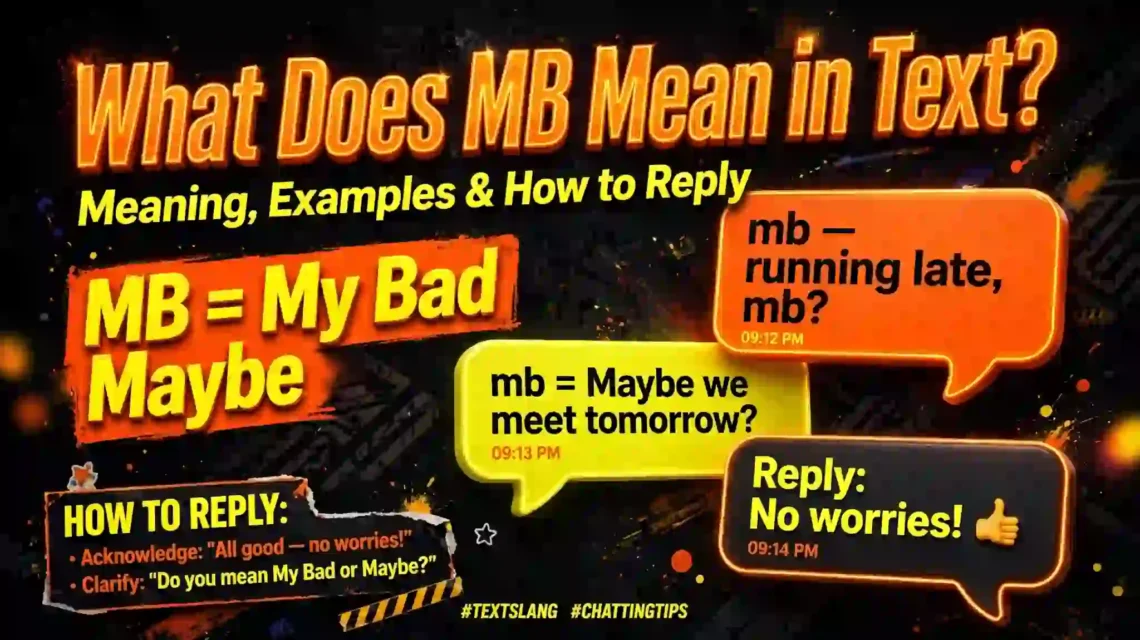
MB usually stands for “My Bad” in texting. People use it to admit a mistake, apologize, or take responsibility for something they did wrong. It offers a quick and casual way to say sorry without writing a long message.
For example:
- Friend: You forgot to send me the picture.
- You: MB! I’ll send it now.
Here, MB means “My Bad.” The sender accepts the mistake and promises to fix it.
People commonly use this abbreviation when they:
- Forget to reply to a message.
- Send incorrect information.
- Make a small mistake.
- Miss a call or appointment.
- Accidentally misunderstand someone.
- Forget something important.
The expression sounds relaxed and friendly. It works well with friends, family members, and people you know well.
However, it may not suit every situation. A serious mistake may need a more thoughtful apology. In those cases, writing a complete sentence shows more care.
What stand mb meaning in text?
The most popular meaning of MB in everyday texting is “My Bad.” Still, the abbreviation can have other meanings in different situations. The surrounding conversation helps you understand what someone wants to say.
Here are some common meanings:
My Bad: This is the most common meaning in casual conversations. It shows that someone accepts responsibility for a mistake.
Maybe: Some people use MB as a shortened form of maybe. However, this use is less common and can cause confusion.
Megabyte: In technology, MB stands for megabyte. It describes a unit of digital information or file size.
Message Back: In certain conversations, someone may use MB to refer to messaging back. This meaning depends heavily on context.
MB as My Bad
This meaning appears frequently in text messages. Someone may use it after forgetting something or making a small error.
Example:
- Alex: You sent the wrong address.
- Sam: MB, here’s the correct one.
Sam admits the mistake and provides the right information.
MB as Maybe
Some people shorten words when they want to type quickly. MB can sometimes mean maybe, but this is not a standard texting interpretation.
Example:
- Alex: Are you coming to the party?
- Sam: MB, I’ll let you know.
The conversation suggests that Sam has not made a final decision.
MB as Megabyte
In technology discussions, MB has a completely different meaning. It refers to a unit used to measure digital data.
Example:
- Alex: How large is the picture?
- Sam: It’s around 5 MB.
Here, the abbreviation has nothing to do with an apology. It describes the image’s file size.
MB Meaning in Text on Snapchat, Instagram, and TikTok
Social media platforms encourage short messages and quick replies. Users often include abbreviations in comments, direct messages, captions, and group chats. The mb meaning in text generally stays the same across these platforms.
However, the situation can help you understand the sender’s intention.
MB Meaning on Snapchat
MB on Snapchat usually means “My Bad.”
People use it in snaps and private chats when they make a small mistake or forget to respond.
Examples:
- Sorry, MB! I opened your snap by accident.
- MB, I forgot to reply yesterday.
- MB, I sent you the wrong picture.
- Oh, MB! I didn’t see your message.
Snapchat conversations often move quickly. This abbreviation helps users apologize without interrupting the flow of a conversation.
MB Meaning on Instagram
On Instagram, MB usually stands for “My Bad” in direct messages and comments.
For example:
- MB, I tagged the wrong person.
- MB! I meant to send that to someone else.
- Sorry, MB. I missed your DM.
You may also see it in group conversations. Someone might use it after sharing incorrect information or misunderstanding a comment.
MB Meaning on TikTok
TikTok users also use MB in comments and private messages. It usually expresses a quick apology.
Examples:
- MB, I misunderstood your comment.
- MB, I thought you meant something else.
- Oh, MB! You’re right.
The platform does not change the basic meaning. Always read the surrounding message to understand the intended use.
How to Use MB in Text Messages
Using MB is simple. You can add it at the beginning or end of a message when you want to acknowledge a small mistake.
The expression works best in informal conversations. It helps you sound relaxed while accepting responsibility.
Here are several situations where you can use it.
When You Forget to Reply
People sometimes get busy and forget to answer messages. MB offers a quick way to acknowledge the delay.
Examples:
- MB, I just saw your message.
- Sorry, MB! I got caught up with work.
- MB for replying so late.
- Oh, MB! I completely forgot to text back.
When You Send the Wrong Message
A quick apology can clear up confusion when you send something to the wrong person.
Examples:
- MB, that message wasn’t meant for you.
- Oops, MB! Wrong chat.
- MB, I sent the wrong screenshot.
- Sorry, please ignore that message.
When You Make a Small Mistake
You can also use this abbreviation when you get something wrong during a conversation.
Examples:
- MB, I got the date wrong.
- You’re right, MB!
- MB, I misunderstood what you said.
- My mistake, I didn’t notice that.
When You Miss a Call
MB can help you acknowledge a missed call and explain why you did not answer.
Examples:
- MB, I was away from my phone.
- MB, I couldn’t pick up earlier.
- Sorry, I just noticed your call.
- MB, I’ll call you back soon.
How to Reply to mb meaning in text
Your reply depends on the situation and your relationship with the sender. In most casual conversations, you do not need a long response. A short, friendly message works perfectly.
The mb meaning in text often shows that someone recognizes a mistake. Your response can accept the apology, reassure the person, or keep the conversation going.
Here are some natural replies.
Casual Replies to MB
Use these responses when a friend or family member apologizes for a small mistake.
- No worries!
- It’s all good.
- You’re fine.
- No problem at all.
- Don’t worry about it.
- All good here.
- It’s okay!
- No big deal.
- Happens to everyone.
- We’re good!
Funny Replies to mb meaning in text
A little humor can make the conversation more enjoyable. These replies work well when the mistake is harmless.
- Haha, you’re forgiven!
- I’ll let it slide this time.
- Your apology has been accepted.
- Mistakes happen, legend!
- You’re lucky I’m nice.
- Haha, no stress!
- Case closed!
- It’s fine, human error happens.
- I’ll pretend I didn’t notice.
- Apology accepted, carry on!
Sweet Replies to mb meaning in text
Choose a warm response when someone feels bad about a small mistake.
- It’s okay, don’t feel bad.
- No worries, take care.
- You’re always forgiven.
- Don’t overthink it.
- It’s completely fine.
- I understand, no problem.
- You’re good with me.
- No need to apologize.
- It happens, sweetheart.
- Everything is okay!
Short Replies to mb meaning in text
Sometimes, one or two words are enough to keep the chat moving.
- All good.
- No worries.
- It’s fine.
- No stress.
- Okay!
- Sure!
- You’re good.
- No problem.
- Chill!
- It’s cool.
MB vs. Other Common Texting Abbreviations
Texting slang includes many abbreviations that look similar but carry different meanings. Understanding these differences helps you avoid confusion.
Here are some common expressions you may see in everyday chats.
| Abbreviation | Full Meaning | Common Use |
| MB | My Bad | Admitting a mistake |
| SRY | Sorry | Apologizing |
| NVM | Never Mind | Dropping a subject |
| NP | No Problem | Accepting an apology |
| IDC | I Don’t Care | Showing a lack of concern |
| IMO | In My Opinion | Sharing an opinion |
| BTW | By The Way | Adding information |
| TBH | To Be Honest | Expressing honesty |
| BRB | Be Right Back | Temporarily leaving |
| OMW | On My Way | Saying you are traveling |
MB vs. SRY
Both expressions can communicate an apology, but they have slightly different tones.
MB means “My Bad.” It usually admits responsibility for a small mistake.
SRY means “Sorry.” It directly expresses an apology and can fit more situations.
Examples:
- MB, I forgot your birthday.
- SRY, I forgot your birthday.
Both messages express regret. However, SRY sounds more direct.
MB vs. NP
These abbreviations often appear together in conversations.
MB means “My Bad,” while NP means “No Problem.”
Example:
- Alex: MB, I forgot to send the notes.
- Sam: NP, you can send them later.
One person admits a mistake, and the other accepts the apology.
MB vs. NVM
These abbreviations serve different purposes.
MB means “My Bad,” while NVM means “Never Mind.”
Example:
- Alex: MB, I gave you the wrong time.
- Sam: NVM, I figured it out.
Understanding these differences makes online conversations easier.
Is MB Rude or Disrespectful?
No, MB is not usually rude or disrespectful. It is a casual expression that people use to acknowledge mistakes. Most friends and people who communicate informally understand it as a quick apology.
However, the tone depends on the situation.
When MB sounds friendly:
- A friend forgets to reply.
- Someone sends the wrong picture.
- A person makes a small mistake.
- Someone accidentally interrupts a conversation.
When MB may sound careless:
- Someone makes a serious mistake.
- A person hurts someone’s feelings.
- Someone ignores an important responsibility.
- A professional conversation requires a formal apology.
For example, sending only “MB” after hurting someone’s feelings may seem dismissive.
A better response would be:
“I’m really sorry. I didn’t mean to hurt your feelings, and I’ll be more careful next time.”
This response shows responsibility and genuine concern.
Remember that short abbreviations work best for minor situations. Serious conversations deserve clear and thoughtful words.
When Should You Avoid Using MB?
Although this abbreviation is useful, it does not fit every conversation. Knowing when to avoid it can help you communicate more respectfully.
Here are some situations where writing the full phrase is a better choice.
Professional Emails
Avoid using MB in formal business emails. Instead, write a complete apology.
For example:
“I’m sorry for the confusion. I have corrected the information and attached the updated document.”
This sounds more professional and respectful.
Serious Mistakes
If your mistake affects another person, a short abbreviation may not express enough regret.
Use a thoughtful apology that explains what happened and how you plan to fix it.
Conversations With New People
Not everyone understands texting slang. When communicating with someone for the first time, clear language prevents misunderstandings.
Important Discussions
Sensitive topics require careful communication. Avoid using abbreviations when someone expects a serious response.
A complete sentence can make your intentions easier to understand.
Common Mistakes People Make When Using MB
Even simple texting abbreviations can cause confusion. Some people misunderstand the meaning or use it in situations where it does not fit.
Here are common mistakes to avoid.
Assuming MB always means My Bad: Context matters. In technology discussions, it may refer to megabytes.
Using it for serious apologies: A short abbreviation may sound careless when someone expects a genuine apology.
Confusing MB with Maybe: Although some people use MB for maybe, “My Bad” is the more common texting meaning.
Using it in every conversation: Repeating the same abbreviation can make messages feel less personal.
Ignoring the other person’s feelings: Saying MB does not automatically fix a mistake. Sometimes, you need to explain yourself or take action.
Using it without context: If someone does not understand the abbreviation, write the complete phrase to avoid confusion.
Good communication is not just about using short words. It is about making sure the other person understands your message.
FAQs About MB Meaning in Text
These frequently asked questions explain how people use this abbreviation in everyday digital conversations.
1. What Does MB Mean From a Girl?
When a girl sends MB in a casual conversation, she usually means “My Bad.” She may use it after forgetting something, making a mistake, or replying late. The exact meaning depends on the context of her message.
2. What Does MB Mean From a Guy?
When a guy texts MB, it generally means “My Bad.” He may be apologizing for a small mistake or acknowledging something he did wrong. It usually has a casual and friendly tone.
3. Does MB Mean My Bad or Maybe?
MB most commonly means “My Bad” in everyday texting. Some people also use it to mean “Maybe,” but this interpretation is less common. Read the complete conversation to understand the intended meaning.
4. What Does MB Mean on Snapchat?
On Snapchat, MB usually stands for “My Bad.” People use it in snaps and private chats to apologize for small mistakes, missed replies, or accidental messages.
5. How Do You Respond to MB?
You can respond with simple phrases such as “No worries,” “All good,” “It’s okay,” or “No problem.” Choose a reply that matches the situation and your relationship with the sender.
6. Is MB the Same as Sorry?
MB and sorry have similar meanings, but they are not exactly the same. MB means “My Bad” and usually accepts responsibility for a mistake. Sorry is a more general expression of apology.
Conclusion
Understanding common texting abbreviations makes online conversations easier.mb meaning in text is one of the simplest expressions you may encounter in everyday chats. It usually means “My Bad” and helps people acknowledge small mistakes without writing a long apology.You may see it on Snapchat, Instagram, TikTok, and other messaging platforms.
People often use it when they forget to reply, send the wrong message, miss a call, or misunderstand something.The best way to respond depends on the situation. Simple replies like “No worries,” “All good,” and “It’s okay” work well in casual conversations. For serious mistakes, a complete and thoughtful apology is a better choice.