
When it comes to online conversations, short forms and slang words make communication faster and easier. One popular abbreviation you may see in text messages, social media comments, and online chats is IMO. People use it to share opinions, express thoughts, and respond to discussions without typing long sentences. But what does it actually mean?
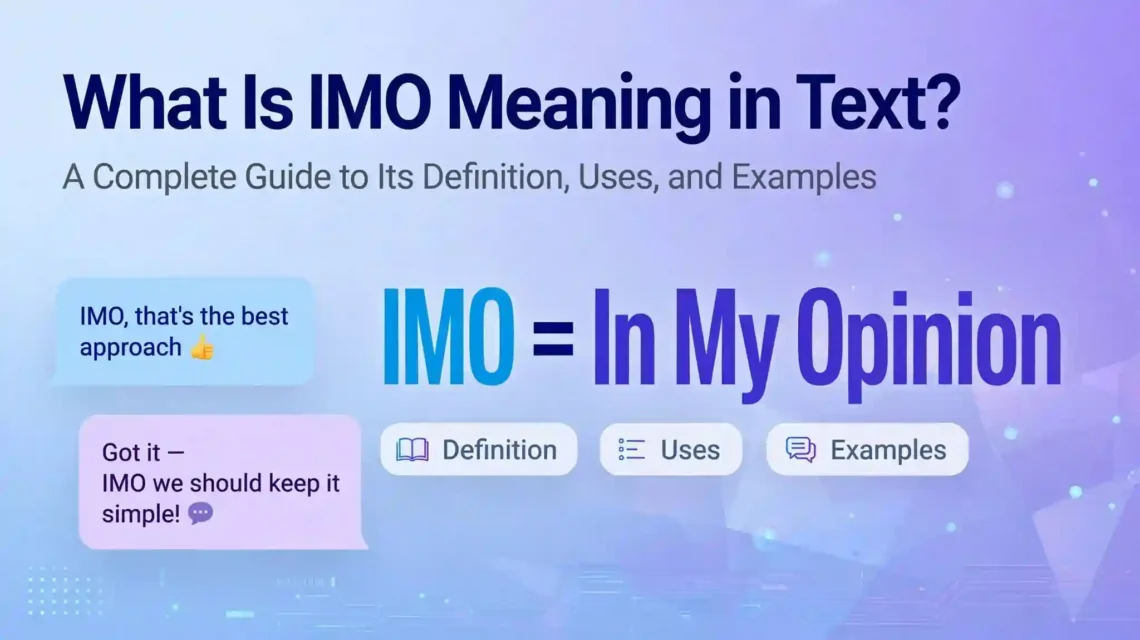
The IMO meaning in text is “In My Opinion.” It tells the reader that someone is sharing a personal view rather than stating a proven fact. You can use it in friendly chats, social media posts, gaming conversations, and online discussions. This guide explains its meaning, common uses, examples, differences from similar abbreviations, and mistakes to avoid.
What does imo meaning in text?
IMO stands for In My Opinion. People use this abbreviation when they want to share a personal thought or viewpoint. It helps readers understand that a statement reflects someone’s belief, preference, or judgment.
For example:
- IMO, this movie is worth watching.
- IMO, blue looks better than black.
- IMO, this restaurant serves the best pizza.
In each example, the speaker shares a personal opinion. They do not claim that everyone must agree.
The abbreviation is common in digital communication because it saves time. Instead of writing three full words, you can simply type IMO.
It also makes conversations feel more natural. When people discuss movies, games, fashion, food, or daily life, they often use this short form to introduce their views.
What Does Each Letter in IMO Stand For?
The abbreviation contains three letters. Each letter represents one word.
- I: In
- M: My
- O: Opinion
Together, they form the phrase In My Opinion.
The phrase tells readers that the following statement comes from personal experience or individual judgment.
For example, consider this sentence:
“IMO, online learning is more flexible than classroom learning.”
The writer shares a personal belief. Another person may prefer traditional classes. Both opinions can be valid.
Is IMO a Word or an Abbreviation?
IMO is an internet abbreviation. It is not a traditional English word. People use it as a shortcut for a common phrase.
You can write it in uppercase or lowercase:
- IMO
- imo
Both forms have the same meaning. Uppercase is common in formal typing, while lowercase often appears in casual messages.
How is imo meaning in text used in messages?
People use IMO to introduce opinions in everyday digital conversations. It works well when someone wants to express a preference, make a suggestion, or join a discussion.
You can place it at the beginning or middle of a sentence. The position depends on your writing style.
1. Sharing Personal Opinions
The most common use is sharing personal thoughts.
Examples:
- IMO, this is the best phone on the market.
- IMO, the new update looks great.
- IMO, reading books is better than watching television.
These sentences show personal preferences. They do not present universal facts.
2. Giving Advice
You can also use IMO when offering advice to friends or family.
Examples:
- IMO, you should take a short break.
- IMO, that job is a good opportunity.
- IMO, you should save money before buying a new car.
This approach makes advice sound less forceful. It shows that you are sharing a suggestion rather than giving an order.
3. Joining Online Discussions
Online discussions often involve different opinions. IMO helps users share their thoughts without sounding too aggressive.
Examples:
- IMO, the first season was better.
- IMO, this team needs a stronger defense.
- IMO, the new design looks more professional.
It is especially useful in forums, comment sections, and social media groups.
4. Expressing Preferences
People also use the abbreviation when comparing two or more things.
Examples:
- IMO, Android offers more customization.
- IMO, tea tastes better than coffee.
- IMO, summer is the best season.
These examples show personal choices. Other people may have different preferences.
What is imo meaning in text on Social Media?
The meaning stays the same across most social media platforms. Users write IMO to share their thoughts in short posts, replies, comments, and private messages.
You may encounter it on WhatsApp, Instagram, Facebook, TikTok, Snapchat, Reddit, and other online platforms.
IMO Meaning in text on WhatsApp
On WhatsApp, people use IMO in personal chats and group conversations.
For example:
Friend 1: Which restaurant should we visit tonight?
Friend 2: IMO, the Italian place is better.
Here, the second person shares a personal recommendation.
IMO Meaning in text on Instagram
Instagram users often add IMO to comments and discussions.
Example:
“IMO, this outfit looks amazing!”
The user expresses a personal opinion about someone’s appearance or style.
IMO Meaning in text on Facebook
Facebook users may use IMO when discussing news, entertainment, products, and everyday topics.
Example:
“IMO, this is the best feature Facebook has introduced.”
The abbreviation helps separate personal views from factual information.
IMO Meaning in text on TikTok
TikTok users often use short abbreviations in comments and captions.
Example:
“IMO, the original video was much better.”
It helps users share quick reactions without writing lengthy comments.
What Is the Difference Between IMO and IMHO?
IMO and IMHO are similar internet abbreviations. Both introduce personal opinions, but they contain different words.
- IMO: In My Opinion
- IMHO: In My Humble Opinion
IMHO adds the word “humble.” It can make a statement sound more modest or polite.
Consider these examples:
- IMO, this is the best movie of the year.
- IMHO, this is the best movie of the year.
Both sentences express a personal view. However, the second version uses a phrase that suggests modesty.
IMO vs. IMHO: Key Differences
| Feature | IMO | IMHO |
| Full form | In My Opinion | In My Humble Opinion |
| Meaning | Personal viewpoint | Personal viewpoint expressed modestly |
| Length | 3 letters | 4 letters |
| Tone | Neutral and casual | Often more modest |
| Common use | Chats and comments | Discussions and online forums |
Neither abbreviation is always more polite. The tone depends on the conversation and the way you write the rest of your message.
What Is the Difference Between IMO and Other Text Abbreviations?
Online communication includes many abbreviations that look similar. Some express opinions, while others show agreement, disagreement, or reactions.
Learning these terms can help you understand messages more easily.
1. IMO vs. IMHO
IMO means In My Opinion, while IMHO means In My Humble Opinion.
Both introduce personal thoughts. The main difference is the addition of the word humble.
2. IMO vs. TBH
TBH stands for To Be Honest.
People use it when they want to express an honest thought or feeling.
Examples:
- IMO, this game is difficult.
- TBH, I do not enjoy this game.
IMO introduces an opinion. TBH emphasizes honesty.
3. IMO vs. FYI
FYI stands for For Your Information.
People use it to share information that someone may find useful.
Examples:
- IMO, this is the best option.
- FYI, the meeting starts at 10 AM.
The first statement expresses a viewpoint. The second provides information.
4. IMO vs. IMAO
IMAO is sometimes used online as an informal variation of IMAO-related slang, but it is not as widely standardized as IMO. Be careful not to confuse it with common abbreviations.
A more familiar expression is LMAO, which means Laughing My Ass Off. It expresses strong amusement rather than an opinion.
5. IMO vs. IDC
IDC means I Don’t Care.
Examples:
- IMO, we should choose the cheaper option.
- IDC which movie we watch.
These abbreviations have very different purposes. IMO introduces a viewpoint, while IDC expresses a lack of concern.
How to Use IMO meaning in text Correctly in a Sentence
Using IMO is simple. You only need to place it before or within a sentence that expresses your personal opinion.
Here are some practical ways to use it.
Start a Sentence With IMO
This is one of the most common writing styles.
Examples:
- IMO, this book is worth reading.
- IMO, the blue design looks better.
- IMO, you made the right decision.
A comma after IMO improves readability, although casual messages may not always include one.
Use IMO in the Middle of a Sentence
You can also place it within a sentence.
Examples:
- This is, IMO, the best restaurant in town.
- The new version is better, IMO.
- That was the smartest choice, IMO.
This style works well in online comments and informal writing.
Use IMO in Casual Conversations
IMO is suitable for friendly messages, online chats, and informal discussions.
Examples:
- IMO, we should leave early.
- IMO, that was a great performance.
- IMO, you need a better laptop.
However, avoid relying on abbreviations in formal reports, academic papers, and professional documents. Writing the full phrase is usually clearer.
Common Mistakes People Make When Using IMO
Although the abbreviation is simple, people sometimes misunderstand its purpose or use it incorrectly.
Here are some mistakes worth avoiding.
1. Treating an Opinion as a Fact
IMO introduces a personal belief. It does not make an opinion a proven fact.
For example:
“IMO, water boils at 100°C at standard atmospheric pressure.”
This sentence introduces a scientific fact as an opinion. A clearer version would simply state the fact.
Use IMO for preferences, judgments, and personal viewpoints.
2. Using IMO in Every Sentence
Adding IMO repeatedly can make your writing look unnatural.
Instead of writing:
“This phone is good. Its camera is excellent, and the battery also lasts a long time.”
Try:
“IMO, this phone is good. Its camera is excellent, and the battery lasts a long time.”
Use the abbreviation when it adds meaning.
3. Confusing IMO With IMHO
These abbreviations have related meanings, but they are not identical.
Remember:
- IMO means In My Opinion.
- IMHO means In My Humble Opinion.
Both express personal views, but IMHO includes an additional word.
4. Using It in Formal Writing
IMO is common in casual digital communication. However, it may look unprofessional in business reports, academic assignments, and official documents.
Instead, write:
- In my opinion
- From my perspective
- I believe
- In my view
These expressions sound more appropriate in formal settings.
5. Forgetting the Context
A short abbreviation may not make sense to every reader. Some people may not understand internet slang.
If you are speaking with someone unfamiliar with texting abbreviations, use the full phrase.
Clear communication should always come before shortcuts.
Examples of IMO meaning in text in Real-Life Conversations
The easiest way to understand an abbreviation is to see how people use it in everyday situations.
Here are some natural examples from different types of conversations.
Conversation 1: Talking About Movies
Alex: Have you watched the new action movie?
Sam: Yes! IMO, the story was better than the special effects.
Meaning: Sam shares a personal opinion about the movie.
Conversation 2: Discussing Food
A: Which pizza should we order?
B: IMO, the chicken pizza tastes better.
Meaning: The speaker recommends a personal favorite.
Conversation 3: Talking About Technology
Friend 1: Should I buy a new laptop?
Friend 2: IMO, you should choose one with more RAM.
Meaning: The second friend offers personal advice.
Conversation 4: Discussing Fashion
A: Do you like this jacket?
B: IMO, the black one looks more stylish.
Meaning: The speaker expresses a fashion preference.
Conversation 5: Talking About Education
Student 1: Is online learning better than classroom learning?
Student 2: IMO, both have advantages, but classroom learning offers more direct interaction.
Meaning: The student shares a personal viewpoint.
Conversation 6: Discussing Sports
A: Who is the best player on the team?
B: IMO, the captain has the strongest overall performance.
Meaning: The speaker gives a personal judgment.
Is IMO Rude, Polite, or Informal?
IMO is generally informal and neutral. It is not rude by itself. People use it to introduce their thoughts in everyday conversations.
However, the tone of your message depends on the words that follow it.
Compare these examples:
Polite:
“IMO, we could try a different approach.”
Direct:
“IMO, your plan will not work.”
Friendly:
“IMO, you picked the best option!”
Disrespectful:
“IMO, your idea is stupid.”
The abbreviation does not make an insulting statement polite. Your word choice and attitude matter more.
If you want to disagree respectfully, try phrases such as:
- IMO, I see things differently.
- IMO, another option might work better.
- IMO, we should consider both sides.
- IMO, there may be a simpler solution.
These expressions help you share a different opinion without creating unnecessary conflict.
Benefits of Using IMO in Online Communication
Short abbreviations have become a regular part of digital conversations. IMO offers several practical benefits when people use it correctly.
1. Saves Time
Typing three words takes longer than typing three letters. IMO makes quick conversations easier.
2. Makes Opinions Clear
Readers can recognize that you are sharing a personal viewpoint rather than presenting a universal fact.
3. Supports Friendly Discussions
It can make suggestions and disagreements sound less forceful when used with respectful language.
4. Fits Different Platforms
You can use it in text messages, social media comments, online forums, and gaming chats.
5. Keeps Messages Short
Short messages are useful on platforms where users prefer quick replies.
Are There Any Disadvantages?
Yes. Like other internet abbreviations, IMO has a few limitations.
- Some readers may not understand it.
- It may look too casual in professional communication.
- It cannot make an offensive statement respectful.
- Repeated use can make writing feel unnatural.
- It may not suit formal or academic writing.
The best approach is to consider your audience before using it.
Frequently Asked Questions (FAQs)
1. What Is the IMO Meaning in Text?
IMO means In My Opinion. People use it in text messages and online conversations to introduce a personal thought, belief, preference, or viewpoint.
For example, “IMO, this is the best restaurant in town” means the speaker personally believes that the restaurant is the best.
2. What Does IMO Mean From a Girl?
IMO has the same meaning regardless of gender. If a girl uses it in a message, she is simply sharing her personal opinion.
For example, “IMO, you should try the blue dress” means she thinks the blue dress is a better choice.
3. What Does IMO Mean From a Guy?
When a guy writes IMO, he means In My Opinion. He may use it to share advice, discuss a topic, or express a personal preference.
The abbreviation does not have a special romantic meaning.
4. What Does IMHO Mean?
IMHO stands for In My Humble Opinion. It is similar to IMO but adds the word humble.
People use it when they want to express a personal viewpoint in a modest or casual way.
5. Can I Use IMO in Professional Messages?
You can use it in relaxed workplace chats if your colleagues understand internet abbreviations. However, avoid it in formal emails, reports, and official documents.
Use “In my opinion” or “From my perspective” when you need a professional tone.
6. Is IMO Still Used in Texting?
Yes. IMO remains a recognizable internet abbreviation. People continue to use it in text messages, online discussions, social media comments, and gaming conversations.
Its simple meaning makes it easy to understand across different digital platforms.
Conclusion
IMO is a simple but useful abbreviation in modern digital communication. It stands for In My Opinion and helps people share personal thoughts without typing a long phrase. You can use it when discussing movies, food, fashion, technology, sports, education, and everyday topics.
The IMO meaning in text is easy to remember: it simply introduces a personal opinion. Use it naturally, choose the right setting, and avoid adding it to every sentence. When communicating in professional or academic settings, write the complete phrase instead. Clear and respectful communication will always matter more than using internet slang.