
When it comes to texting, short forms can make conversations faster, but they can also confuse readers who have never seen them before. One common example is OML, a casual texting abbreviation used across chats, social media, comments, and direct messages. If you recently received a message containing OML, you may wonder what the sender meant and how you should respond.
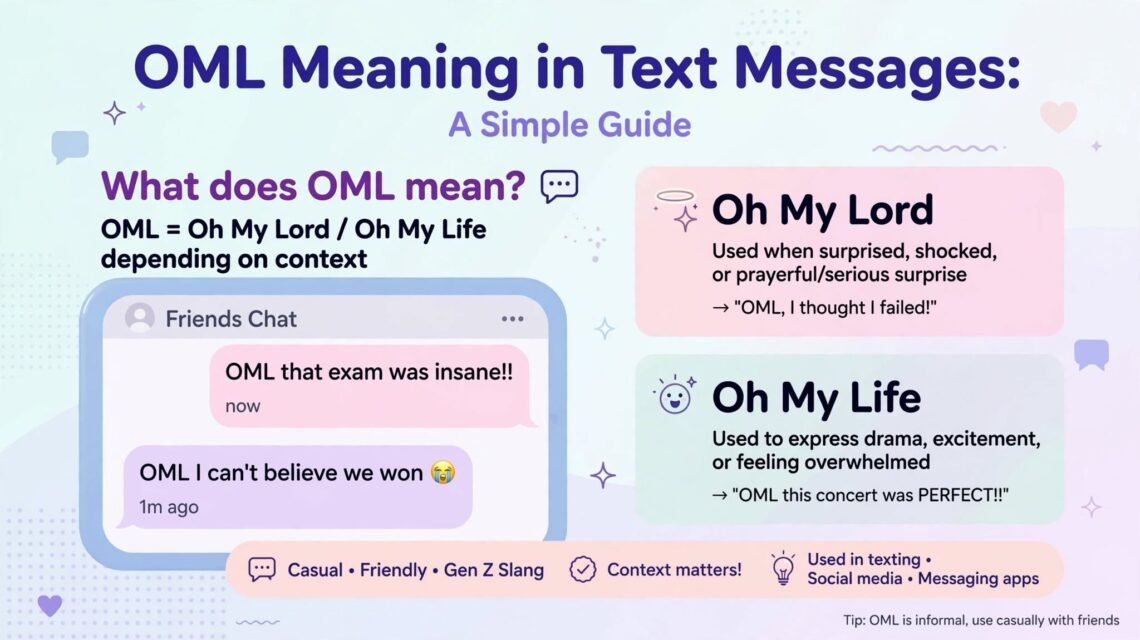
The OML meaning in text is usually “Oh My Lord” or “Oh My Life,” depending on the person and the context. It often shows surprise, shock, excitement, frustration, disbelief, or strong emotion. This guide explains both meanings, shows real-world examples, compares OML with similar abbreviations, and explains how to use it naturally.
What Is the OML Meaning in Text?
OML is a casual internet abbreviation that usually expresses a strong emotional reaction. Its exact meaning depends on the conversation, the sender, and the words surrounding the abbreviation.
In most casual conversations, OML works like an emotional reaction rather than a sentence with a detailed meaning. A person may type it after seeing surprising news, an unexpected photo, a funny message, or something frustrating.
The two most common expansions are:
- Oh My Lord
- Oh My Life
“OH my Lord” often expresses surprise, disbelief, shock, excitement, or frustration. “Oh my life” can serve a similar purpose and is more common in some English-speaking communities.
For example:
“OML, I can’t believe you actually did that!”
Here, OML shows surprise.
Another example is:
“OML, this is the funniest video I’ve seen today.”
In this case, OML adds excitement and emphasis.
Because OML is informal, people normally use it in texting, social media, gaming chats, and casual online conversations. It usually does not belong in formal emails, academic writing, business reports, or professional documents.
What Does OML Stand for in Texting?
OML can stand for different phrases, but “Oh My Lord” and “Oh My Life” are the most common meanings in everyday online communication. Context helps identify the intended version.
OML Meaning: “Oh My Lord”
“Oh My Lord” is one of the most common interpretations of OML. It works as an emotional expression when someone feels surprised, amazed, shocked, annoyed, or overwhelmed.
Consider this conversation:
Friend 1: “I just found out that I won the competition.”
Friend 2: “OML! That’s amazing!”
The abbreviation does not add a specific fact. Instead, it communicates the speaker’s emotional reaction.
You might also see:
- “OML, what just happened?”
- “OML, that’s so cute.”
- “OML, I forgot about the meeting.”
- “OML, you scared me!”
- “OML, this costs so much.”
The emotion changes with the situation.
A positive message can make OML sound excited. A negative message can make it sound frustrated or shocked. That flexibility explains why people use it in many different conversations.
OML Meaning: “Oh My Life”
Another interpretation is “Oh My Life.” This version is especially associated with casual British and international online communication.
For example:
“OML, I can’t believe how quickly this year went.”
The phrase expresses disbelief or amazement.
Someone might also write:
“OML, that was the longest day ever.”
Here, the sender uses OML to emphasize frustration or exhaustion.
Both “Oh My Lord” and “Oh My Life” serve almost the same practical purpose. In many conversations, the exact expansion is less important than the emotion being communicated.
How Is OML Used in Text Messages?
OML usually appears at the beginning of a message, but people can place it anywhere they want to emphasize an emotional reaction. Punctuation and capitalization can also change its tone.
For example:
- “OML!” — strong surprise or excitement
- “oml 😂” — amused reaction
- “OML, seriously?” — disbelief or frustration
- “oml that was amazing” — excitement
- “Oh oml…” — disappointment or shock
People often combine OML with emojis because both help communicate emotion without writing a long explanation.
For example:
“OML 😂 I cannot stop laughing.”
The laughing emoji makes the intended emotion clear.
Another example:
“OML 😭 this is so embarrassing.”
Here, the emoji helps show that the sender feels overwhelmed or embarrassed.
OML at the Beginning of a Message
Starting a message with OML is probably the easiest and most natural way to use the abbreviation. It immediately tells the reader that an emotional reaction is coming.
Example:
“OML, you won’t believe what happened!”
The sender uses OML to build emphasis before explaining the event.
This style is common when someone wants to tell a friend surprising news.
OML as a Standalone Reaction
OML can also appear by itself.
For example:
Person A: “I accidentally sent the screenshot to the person we were talking about.”
Person B: “OML 😭”
The second person does not need to write a complete sentence. OML communicates immediate shock or disbelief.
This is one reason abbreviations are useful in digital conversations. They allow people to communicate emotional reactions quickly.
What Emotions Can OML Express?
The meaning of OML changes according to context, so the same abbreviation can communicate several different emotions. The surrounding words usually provide the strongest clue.
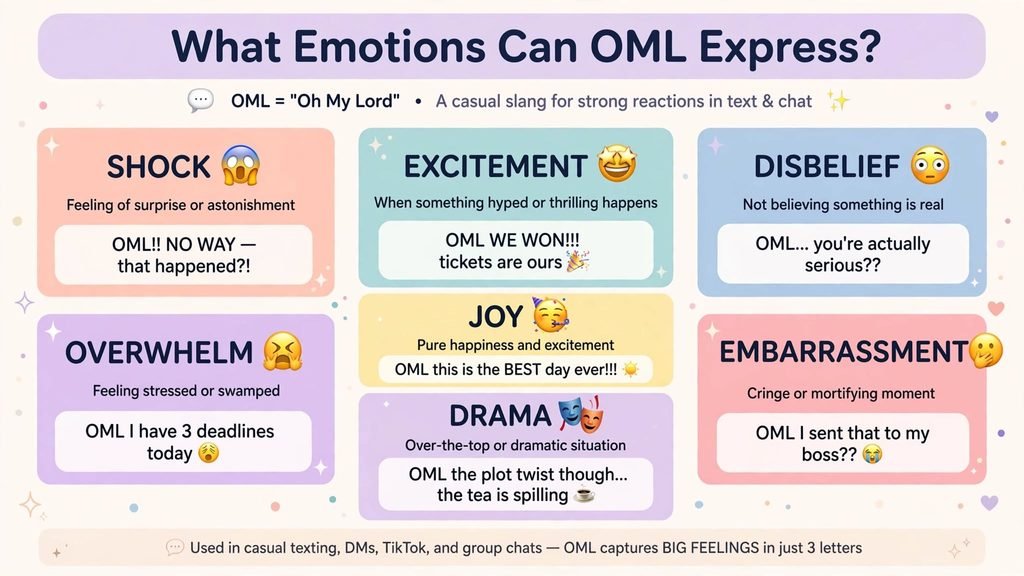
Surprise
Someone may use OML after receiving unexpected information.
“OML, you got the job?”
Here, OML expresses surprise.
Excitement
OML can also show enthusiasm.
“OML, the concert tickets are finally available!”
The sender is excited rather than upset.
Shock
A serious or unexpected event can produce a stronger reaction.
“OML, I didn’t know that happened.”
The abbreviation signals disbelief or shock.
Frustration
OML can express annoyance too.
“OML, my internet stopped working again.”
The phrase adds emotional emphasis to the complaint.
Amusement
In funny conversations, OML can mean that something is extremely funny or entertaining.
“OML 😂 That joke was terrible.”
The surrounding emoji and message make the playful tone clear.
Amazement
Someone may use OML after seeing something impressive.
“OML, that view is incredible!”
In this situation, OML communicates wonder or amazement.
Is OML a Positive or Negative Expression?
OML is neither strictly positive nor negative. Its emotional meaning depends almost entirely on context, punctuation, emojis, and the message around it.
For example:
“OML, your new haircut looks amazing!”
This is clearly positive.
Compare it with:
“OML, I just missed my flight.”
This is negative or stressful.
Another example:
“OML, that’s the funniest thing ever 😂”
This is positive and humorous.
Therefore, you should not assume that OML means the sender is angry or excited without reading the rest of the conversation.
Tone matters in texting because short messages do not include facial expressions, gestures, or voice tone. Abbreviations and emojis often replace those signals.
Is OML Appropriate for Formal Communication?
OML is generally not suitable for formal communication. It belongs mainly to casual digital conversations and informal online communication.
Avoid using OML in:
- Job applications
- Formal business emails
- Academic assignments
- Professional reports
- Official letters
- Client communications
- Legal documents
- Formal presentations
Instead, write the emotion or idea clearly.
For example, instead of:
“OML, I can’t believe the deadline changed.”
A professional message could say:
“I was surprised to learn that the deadline has changed.”
The second version communicates the same basic reaction while maintaining a professional tone.
Casual communication has different expectations. If you are texting a close friend, OML may sound completely natural. If you are writing to a manager, teacher, customer, or client, a complete sentence is usually better.
Common Mistakes When Using OML
Although OML is simple, beginners can misunderstand its meaning or use it in the wrong setting. A few common mistakes are worth avoiding.
Assuming Only One Meaning
Do not assume OML always means “Oh My Lord.” “Oh My Life” is another common interpretation.
The surrounding message can help you understand the intended meaning.
Treating OML as a Complete Sentence
OML usually works as an emotional expression. It does not provide much information by itself.
If someone writes:
“OML!”
You may need to ask what happened.
Using It in Professional Writing
A casual abbreviation can make professional communication seem careless or overly informal. Use complete language when the situation requires a professional tone.
Misreading the Emotion
OML does not always mean something bad. It can communicate happiness, humor, excitement, shock, or frustration.
Always read the full message before deciding what the sender feels.
Overusing Abbreviations
Using too many abbreviations can make a message difficult to read.
For example:
“OML LOL IDK BTW SMH 😂”
may be understandable to some readers but confusing to others.
Clear communication is usually better than using an abbreviation in every sentence.
Examples of OML in Real Conversations
Looking at complete conversations is one of the easiest ways to understand how OML works.
Example 1: Surprise
Alex: “I met our favorite actor today.”
Sam: “OML! Seriously?”
Here, OML expresses surprise.
Example 2: Excitement
Alex: “We got tickets for the final!”
Sam: “OML, that’s incredible!”
Here, OML shows excitement.
Example 3: Frustration
Alex: “The printer stopped working again.”
Sam: “OML, not again.”
The expression emphasizes frustration.
Example 4: Humor
Alex: “I tried cooking without reading the recipe.”
Sam: “OML 😂 How did that go?”
Here, OML communicates amusement and curiosity.
Does OML Mean Something Different on Social Media?
The basic meaning of OML usually stays the same on social media, but users may use it more dramatically or playfully. It can appear in comments, captions, posts, replies, and private messages.
For example:
“OML this picture 😭❤️”
The exact emotion could be admiration, excitement, amusement, or surprise.
On social platforms, people often combine abbreviations with emojis, repeated letters, capitalization, and punctuation.
You may see:
- “OMLLLL 😭”
- “oml 😂”
- “OML!!!”
- “oml this is perfect”
- “OML I can’t”
Extra letters or punctuation usually add emphasis. They do not necessarily create a new definition.
Why Do People Use OML Instead of Writing the Full Phrase?
People use OML because texting encourages fast, compact communication. Short forms save typing time and can make messages feel more casual and expressive.
Digital conversations often move quickly. A three-letter abbreviation can communicate an emotional reaction without requiring a complete sentence.
OML can also help create a friendly online tone. When someone writes:
“OML 😂”
the message feels more spontaneous than a formal sentence such as:
“I find this situation extremely amusing.”
The abbreviation fits the informal nature of texting.
However, speed is not the only reason people use abbreviations. Online language also develops its own culture. Users adopt expressions they see from friends, social media, gaming communities, and other digital spaces.
How to Understand OML Meaning in Text from Context
If you are unsure about an OML message, examine the words before and after it. Context often makes the intended emotion obvious.
Ask yourself:
- What happened immediately before OML?
- Is the message funny, serious, exciting, or frustrating?
- Are there emojis?
- Does the sender normally use texting abbreviations?
- Does the rest of the message suggest “Oh My Lord” or “Oh My Life”?
For example:
“OML 😭 I can’t believe we actually won!”
The word “won” and the crying emoji suggest overwhelming excitement.
On the other hand:
“OML, my train was canceled again.”
suggests frustration.
You do not always need to identify the exact expanded phrase. In many cases, understanding the emotional reaction is more important.
Is OML the Same as “Oh My God”?
OML and “Oh My God” can communicate nearly the same emotional reaction, but they are not identical phrases.
“OMG” directly represents “Oh My God,” while OML commonly represents “Oh My Lord” or “Oh My Life.”
Some people prefer OML because it sounds less direct than “Oh My God.” Others use it simply because they like the abbreviation.
In practical texting, both can express surprise:
“OMG, that’s crazy!”
“OML, that’s crazy!”
The emotional message is very similar.
Still, you should avoid assuming that every person uses OML with exactly the same definition. Personal habits and regional online language can affect how someone uses an abbreviation.
Tips for Using oml meaning in text Naturally
If you want to use OML in your own messages, keep it simple and match the tone of the conversation.
Here are some useful tips:
- Use OML mainly in casual conversations.
- Let the surrounding message explain the emotion.
- Add an emoji when it helps clarify your tone.
- Avoid using it in formal or professional writing.
- Do not assume OML always expresses negativity.
- Use punctuation to add emphasis when appropriate.
- Consider the other person’s communication style.
- If someone uses OML and you are unsure what they mean, ask for clarification.
A natural example is:
“OML, that was so unexpected!”
Frequently Asked Questions About OML Meaning in Text
What does OML mean in a text message?
The OML meaning in text is usually “Oh My Lord” or “Oh My Life.” It expresses emotions such as surprise, shock, excitement, disbelief, amusement, or frustration.
Is OML the same as OMG?
OML and OMG have very similar uses, but they represent different phrases. OMG usually means “Oh My God,” while OML commonly means “Oh My Lord” or “Oh My Life.”
Is OML rude?
OML is generally not considered a rude abbreviation. However, its suitability depends on the conversation. It is best for casual texting and informal online communication rather than formal writing.
Can OML be positive?
Yes. OML can express positive emotions such as excitement, happiness, admiration, and amazement. For example, someone might write, “OML, this is amazing!”
How should I reply to OML?
Look at the context first. If the person is excited, respond positively. If they are upset, offer support. If you do not understand what happened, ask, “What happened?” or “What do you mean?”
Conclusion
The OML meaning in text is usually connected with the phrases “Oh My Lord” or “Oh My Life.” In everyday texting, the abbreviation acts as a quick emotional reaction. It can show surprise, excitement, shock, frustration, amusement, or amazement.OML is most appropriate for casual conversations, social media, gaming chats, and messages between friends. It is generally better to avoid it in formal emails, academic work, business communication, and other professional settings.