
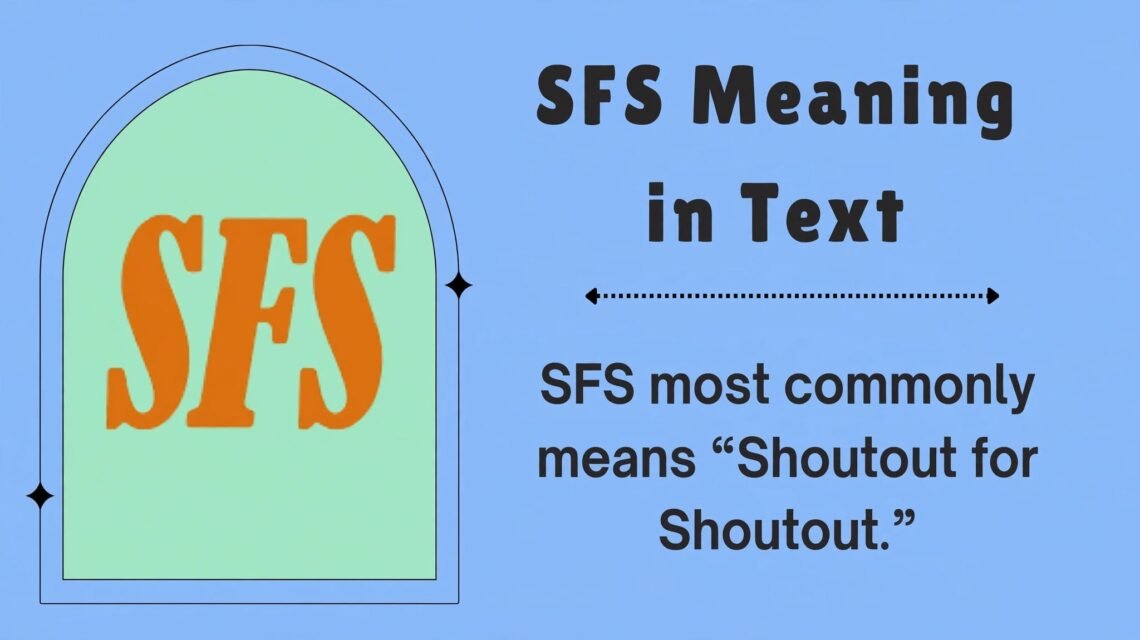
When it comes to texting and social media, short forms can make conversations faster, but they can also create confusion. One abbreviation that appears often in chats, comments, and social platforms is SFS meaning in text. The meaning can change slightly depending on the platform and the conversation. In many cases, SFS means “shoutout for shoutout,” especially on social media. It can also mean “snap for snap” on Snapchat or refer to a similar exchange of promotions or interactions. This guide explains what SFS means, where people use it, how to understand it from context, and how to reply naturally. You will also see practical examples, related abbreviations, common mistakes, and simple ways to tell which meaning fits a particular conversation.
What Does SFS Mean in Texting?
SFS usually refers to an exchange where two people promote, mention, or interact with each other, although the exact meaning depends on the platform and context.
The most common meanings include:
- Shoutout for shoutout
- Snap for snap
- Spam for spam
- Share for share
These expressions all describe a similar idea: one person does something to increase another person’s visibility, and the other person returns the favor.
For example, someone may send “SFS?” after connecting with another user on Snapchat or Instagram. They may be asking whether the other person wants to promote each other’s accounts.
The abbreviation does not always describe a formal promotion. Sometimes users simply use it as a casual way to exchange snaps, posts, stories, likes, or mentions.
The important point is that SFS meaning in text depends on the surrounding conversation. If someone mentions followers, stories, accounts, or promotion, “shoutout for shoutout” is likely. If the conversation centers on Snapchat, “snap for snap” may make more sense.
SFS Meaning in Text on Social Media
On social media, SFS often describes a mutual promotion in which two users help expose each other’s accounts to a wider audience.
The practice became popular because users wanted simple ways to gain followers without paying for traditional advertising. Two accounts could mention each other in posts or stories and potentially introduce their audiences to one another.
A typical exchange might look like this:
- User A sends, “SFS?”
- User B agrees.
- User A posts or mentions User B.
- User B does the same for User A.
- Both users receive exposure to another audience.
The method works best when the two accounts have audiences that are interested in similar content.
For example, a fitness account might exchange shoutouts with another fitness creator. A gaming account could work with another gaming page. A fashion creator might promote another fashion-focused account.
However, SFS does not guarantee followers. A shoutout only creates an opportunity for exposure. People still decide whether they want to follow, interact with, or ignore the promoted account.
Why Do People Use SFS?
People use SFS because it provides a simple way to exchange exposure without directly purchasing advertising.
Common reasons include:
- Growing a social media audience
- Introducing accounts to new users
- Increasing profile visibility
- Promoting similar content
- Building relationships with other creators
- Increasing story or post engagement
- Finding users with similar interests
For smaller creators, this approach can sometimes feel more personal than paid advertising. Instead of placing an advertisement in front of strangers, the creator gets introduced through another account.
Still, users should choose SFS partners carefully. A large follower count does not always mean that an account has an active or relevant audience.
What Does SFS Mean on Snapchat?
On Snapchat, SFS commonly means “snap for snap,” although users may also use it to mean “shoutout for shoutout” or another reciprocal promotion.
The Snapchat context matters because the word “snap” naturally connects the abbreviation to sending Snapchat content.
For example:
Person A: “Want to do SFS?”
Person B: “Sure, send one first.”
Here, the users may be discussing an exchange involving snaps.
In another conversation, SFS might involve promoting each other’s Snapchat usernames. The users could post each other’s profiles or encourage their friends to add the other person.
Because Snapchat users often communicate through very short messages, abbreviations can carry several related meanings. The safest approach is to look at the words around SFS.
If someone talks about:
- Sending snaps
- Snap streaks
- Snapchat usernames
- Adding friends
- Stories
then “snap for snap” is a reasonable interpretation.
If they talk about:
- Followers
- Promotion
- Stories
- Accounts
- Shoutouts
then “shoutout for shoutout” may be more appropriate.
SFS Meaning in Text on Instagram
On Instagram, SFS often relates to exchanging shoutouts, story mentions, or promotional posts between accounts.
Imagine two small creators who produce similar content. One creator might post the other person’s account in an Instagram Story and encourage followers to check it out. The other creator then returns the favor.
A message could be as simple as:
“Hey, SFS?”
The sender may be asking whether the recipient wants to exchange Instagram promotions.
The exact format can vary. One person might share a profile screenshot, tag another account, repost a piece of content, or simply mention the account in a story.
However, users should understand that not every SFS request is worthwhile. An account with many followers may have an audience that does not care about the content being promoted.
For example, a cooking account may gain little value from a shoutout on an unrelated gaming page. A smaller but highly relevant audience may provide better results.
SFS and Audience Quality
Follower numbers alone do not determine whether an SFS partnership is useful.
Consider two possible accounts:
Account A
- 50,000 followers
- Very low engagement
- Unrelated audience
Account B
- 8,000 followers
- Active audience
- Similar content
- Frequent interaction
Account B could be a more useful SFS partner because the audience has stronger relevance.
This is an important lesson for anyone using social media abbreviations as part of a growth strategy: exposure matters, but relevant exposure matters more.
What Does SFS Mean in a Chat?
In a private chat, SFS can have a broader meaning because people may use the abbreviation differently from one platform to another.
A friend might send “SFS?” simply because they want to exchange snaps or social media promotion. Another person may use the same letters to mean “spam for spam,” particularly when asking someone to interact heavily with their content.
Context is the key.
Look at the conversation immediately before and after the abbreviation. Ask yourself:
- Are they discussing Snapchat?
- Are they talking about followers?
- Are they promoting accounts?
- Did they mention stories?
- Are they asking for likes or comments?
- Are they talking about sending pictures?
The answer can usually reveal the intended meaning.
If the context remains unclear, there is nothing wrong with asking:
“What do you mean by SFS?”
That short question can prevent an awkward misunderstanding.
Common SFS Meanings and Their Differences
Although the abbreviation often refers to a reciprocal social media action, different versions can describe slightly different activities.
Shoutout for Shoutout
“Shoutout for shoutout” is one of the most common interpretations on social platforms.
It means two users promote or mention each other. The goal is usually to introduce each account to the other’s audience.
Snap for Snap
“Snap for snap” is especially relevant to Snapchat. It generally suggests exchanging snaps with another user.
Depending on the person, it can also involve promoting Snapchat accounts or usernames.
Spam for Spam
“Spam for spam” can refer to exchanging multiple interactions, such as likes, comments, or other activity on social media posts.
The word “spam” here does not necessarily mean harmful or malicious activity. In casual social media language, users may use it to describe sending or giving many interactions in a short period.
Share for Share
“Share for share” is another related interpretation. One user shares another person’s content, and the other person returns the favor.
This version focuses more directly on content sharing than account shoutouts.
How to Understand SFS From Context
The easiest way to understand an abbreviation is to consider the platform, conversation, and action being requested.
Use this simple process:
Step 1: Identify the platform.
Is the conversation happening on Snapchat, Instagram, TikTok, Facebook, or through ordinary texting?
Step 2: Look at the topic.
Are they discussing followers, photos, stories, messages, or promotions?
Step 3: Identify the requested action.
Does the person want you to send something, share something, tag them, or promote their account?
Step 4: Check previous messages.
Earlier messages often provide the missing clue.
For example, if someone says, “I need 500 more followers. SFS?” the intended meaning is probably related to exchanging promotions.
If someone says, “Send me a snap. SFS?” the meaning may relate more closely to exchanging snaps.
Context is more reliable than assuming that every abbreviation has one universal definition.

SFS Examples in Real Conversations
Examples make abbreviations easier to understand because they show how people use them naturally.
Example 1: Instagram Promotion
Alex: “Hey, want to do SFS?”
Sam: “Sure. I’ll post you on my story if you post me too.”
Here, SFS means a mutual shoutout.
Example 2: Snapchat
Alex: “SFS?”
Sam: “Yeah, send me a snap.”
Here, the conversation suggests “snap for snap.”
Example 3: Growing an Account
Alex: “Trying to grow my page. SFS?”
Sam: “Sure, our content is pretty similar.”
This likely refers to exchanging promotions.
Example 4: Asking for Clarification
Alex: “SFS?”
Sam: “Do you mean shoutout for shoutout?”
This is a useful response when the abbreviation is unclear.
Example 5: Declining
Alex: “Want to do SFS?”
Sam: “Thanks, but I’m not doing shoutouts right now.”
This keeps the response polite while clearly declining.
SFS vs. Other Texting Abbreviations
SFS is only one of many short forms used in digital communication. Understanding similar terms can make social media conversations easier.
| Abbreviation | Common Meaning | Typical Context |
| SFS | Shoutout for shoutout / Snap for snap | Social media |
| F4F | Follow for follow | Social media growth |
| L4L | Like for like | Social media engagement |
| C4C | Comment for comment | Posts and content |
| DM | Direct message | Private social messages |
| TBH | To be honest | Casual texting |
| IMO | In my opinion | Chats and discussions |
| IRL | In real life | Online conversations |
These abbreviations can overlap in purpose. For example, F4F focuses on exchanging follows, while SFS often focuses on mutual promotion.
Knowing the difference helps you understand what another user actually wants before agreeing.
Common Mistakes When Using SFS
People sometimes misunderstand or misuse abbreviations because they assume every platform uses them in exactly the same way.
One common mistake is assuming that SFS always means “shoutout for shoutout.” While that interpretation is widespread, context can change the meaning.
Another mistake is agreeing to an exchange without discussing what each person will do.
Before an SFS exchange, it can help to clarify:
- Which platform you will use
- Whether you will post a story or regular post
- How long the promotion will remain visible
- Whether both accounts will post at the same time
- What content each person will share
Clear expectations can prevent disagreements.
Users should also avoid judging an account only by follower count. An account with a smaller but engaged audience may offer more useful exposure than a large account with little interaction.
Finally, do not assume that every SFS request is trustworthy. If someone asks for sensitive information, money, passwords, or access to an account, stop and verify the request.
Is SFS Good for Social Media Growth?
SFS can help with visibility, but its results vary widely. It works best when both accounts have relevant audiences and create content that viewers actually want to explore.
Potential Benefits
- It can increase exposure.
- It can introduce creators to new audiences.
- It can support networking.
- It may help smaller accounts discover similar creators.
- It can encourage reciprocal promotion.
Possible Drawbacks
- The new audience may not be interested.
- Followers gained through promotion may not remain active.
- Poorly matched accounts may produce little value.
- Too many promotional posts can make a profile feel repetitive.
- Some users may use SFS requests as spam.
For these reasons, SFS should be viewed as one social media tactic rather than a guaranteed growth method.
Quality content, consistent activity, audience relevance, and genuine engagement still matter.
Is SFS Safe to Use?
The abbreviation itself is harmless. However, users should consider the behavior behind any social media request.
A normal SFS request might involve sharing a public profile or mentioning an account. That is very different from someone requesting private login details.
Never share:
- Passwords
- Verification codes
- Private account recovery information
- Financial details
- Sensitive personal information
Be careful if someone pressures you to click an unfamiliar link or asks you to install software to complete an SFS exchange.
You can participate in ordinary social media promotion without giving another person control of your account.
Frequently Asked Questions About SFS
What does SFS mean in texting?
SFS meaning in text commonly refers to “shoutout for shoutout,” especially when users discuss social media promotion. On some platforms, it can also mean “snap for snap” or another reciprocal activity.
What does SFS mean on Snapchat?
On Snapchat, SFS can mean “snap for snap.” It may also refer to exchanging shoutouts or promoting each other’s Snapchat accounts. The surrounding conversation determines the intended meaning.
Does SFS mean shoutout for shoutout?
Yes, “shoutout for shoutout” is one of the most common meanings. It describes a mutual arrangement where two users promote or mention each other’s accounts.
What should I reply to SFS?
If you want to participate, you can say “Sure!” or ask what type of SFS they mean. If you are unsure, simply ask, “Do you mean shoutout for shoutout?”
Is SFS the same as F4F?
No. F4F usually means “follow for follow,” where two users agree to follow each other. SFS generally involves exchanging shoutouts, promotions, snaps, or similar interactions.
Can SFS help grow followers?
It can increase exposure, but it does not guarantee follower growth. Results depend on the relevance, quality, and engagement of the audiences involved.
Conclusion
Understanding SFS meaning in text becomes much easier when you look at the platform and the surrounding conversation. The abbreviation most often relates to a reciprocal social media action, such as “shoutout for shoutout,” but it can also mean “snap for snap,” “spam for spam,” or “share for share.” Snapchat and Instagram users may use the term differently, so context matters.