
When it comes to texting, short forms can make a simple message confusing. One common example is FWB meaning in text, which often refers to a relationship involving friendship and sexual intimacy without a traditional romantic commitment. However, the exact meaning can depend on context. Someone may use FWB while discussing dating, relationships, boundaries, or a casual arrangement. Understanding the term helps you read messages correctly and avoid confusing it with other dating abbreviations. In this guide, you will learn what FWB means, how people use it in text messages, what it implies, how it differs from dating, and how to respond when someone uses the term.
What Does FWB Mean in Text?
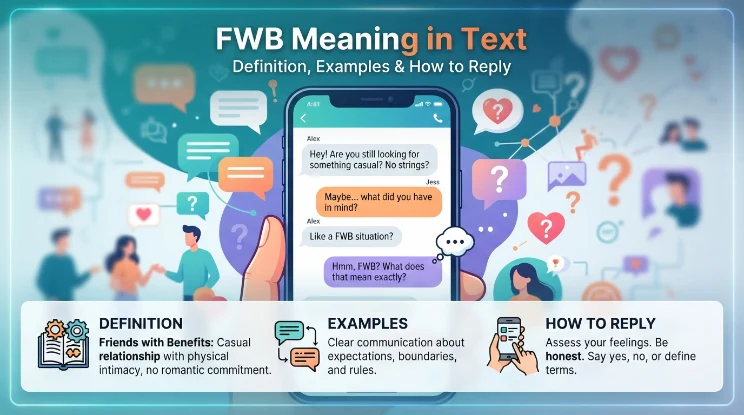
FWB meaning in text usually stands for “friends with benefits.” It describes two people who maintain a friendship while also having a sexual relationship, without necessarily becoming a committed romantic couple.
The term combines two ideas: friends and benefits. “Friends” suggests that the people know each other and may share a friendly connection. “Benefits” is a casual way to refer to sexual or physical intimacy.
For example, someone might text:
“Are you looking for an FWB or something serious?”
In this sentence, the person wants to know whether the other individual prefers a casual physical relationship or a committed romantic relationship.
What Does “Friends With Benefits” Actually Involve?
A friends-with-benefits arrangement usually involves a friendship combined with physical intimacy. The exact boundaries can vary widely between individuals.
Some people may spend time together socially, while others mainly meet privately. Some may communicate often, while others keep contact limited. There is no single rulebook that defines every FWB arrangement.
Common features may include:
- A pre-existing friendship or friendly connection
- Physical or sexual intimacy
- No formal commitment to a romantic relationship
- Mutual understanding of the casual nature of the arrangement
- Personal boundaries agreed upon by both people
- Open communication about expectations
FWB Meaning in Texting vs. Dating
FWB meaning in text becomes clearer when you compare the term with dating, a relationship, and casual hookups. These concepts can overlap, but they are not identical.
Dating often involves romantic interest and the possibility of developing a committed relationship. An FWB arrangement usually focuses more on friendship and physical intimacy without the same expectation of romantic commitment.
Consider these simplified differences:
| Term | Common Meaning | Romantic Commitment |
| Dating | Spending time together romantically | May develop |
| Relationship | A committed romantic connection | Usually yes |
| FWB | Friendship plus physical intimacy | Usually no |
| Casual hookup | Primarily physical encounter | Usually no |
| Situationship | Unclear or undefined romantic connection | Uncertain |
These definitions are general. Real-life relationships can be more complicated than labels suggest.
How People Use FWB in Text Messages
People commonly use FWB in dating conversations, social media messages, dating apps, and private chats. The abbreviation saves space and communicates an idea quickly.
Here are several examples of how it may appear.
Example 1: Asking about intentions
“Would you ever consider FWB?”
The sender may be asking whether the recipient is open to a casual physical relationship.
Example 2: Clarifying a relationship
“Don’t worry, we’re not together. We’re FWB.”
The sender is explaining that the relationship is not a traditional romantic partnership.
Example 3: Discussing dating preferences
“I’m not ready for a relationship. Maybe FWB would work.”
This suggests the person wants physical intimacy without the responsibilities or expectations of a committed relationship.
Example 4: Setting expectations
“I’m only interested in FWB right now.”
This statement communicates that the person does not currently want a serious romantic relationship.
Example 5: Asking what someone wants
“Are you looking for dating or FWB?”
The sender is presenting two different relationship options.
Why Do People Use the Abbreviation?
Texting encourages short and familiar expressions. Acronyms such as FWB make conversations faster and can also make sensitive topics feel less direct.
Writing “friends with benefits” can feel more formal or explicit. Using three letters may seem more casual.
People may use the abbreviation when:
- Messaging on dating apps
- Talking about relationship preferences
- Discussing casual relationships
- Asking about romantic intentions
- Explaining their relationship status
- Avoiding a long explanation
Still, abbreviations can create confusion. Someone unfamiliar with the term may misunderstand the message.
What Does FWB Mean When Someone Texts You?
When someone sends FWB in a message, the surrounding conversation matters. The abbreviation normally refers to friends with benefits, but you should not assume exactly what the sender expects.
For example, if someone says:
“I’m interested in FWB.”
They may mean they want a casual sexual relationship with someone they already know.
If they say:
“Would you be okay with FWB?”
They are probably asking whether you would consider that type of arrangement.
How to Ask for Clarification
You do not need to guess what someone means. A simple response can remove uncertainty.
You could ask:
- “What do you mean by FWB?”
- “Are you talking about a casual relationship?”
- “What would that arrangement look like for you?”
- “Are you looking for something casual or romantic?”
- “What expectations would you have?”
Clear questions are especially useful because people can have different ideas about casual relationships.
FWB Meaning in Text and Relationship Expectations
FWB meaning in text is easy to understand, but the expectations behind the abbreviation can be much more complicated.
Two people might agree that they are FWB but have completely different expectations. One person may want frequent communication, while the other may prefer occasional contact. One may expect exclusivity, while the other may assume that both people can date others.
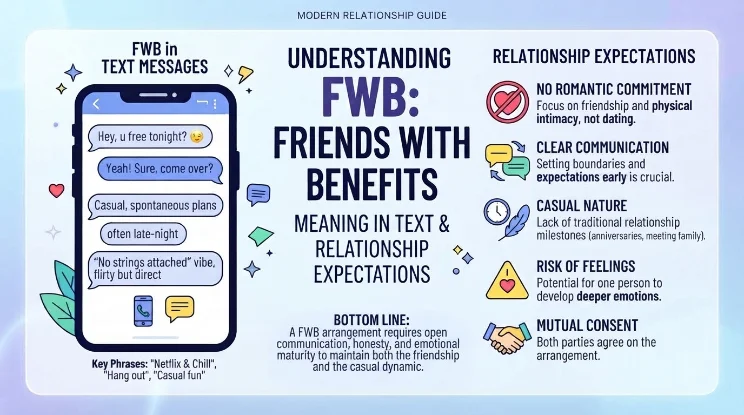
That is why labels alone are not enough.
Before entering any casual arrangement, people should discuss important topics such as:
- Whether the relationship is exclusive
- How often they will communicate
- Whether they will spend time together outside intimacy
- Whether either person can date other people
- What happens if one person develops romantic feelings
- How either person can end the arrangement
- What boundaries each person has
These conversations may feel awkward, but they can prevent bigger problems later.
Advantages and Disadvantages of an FWB Arrangement
An FWB arrangement can have potential benefits, but it can also create emotional and practical challenges. The experience depends heavily on the people involved and how clearly they communicate.
Possible Advantages
Some people prefer FWB because it may offer intimacy without the commitment associated with a traditional romantic relationship.
Potential advantages include:
- Less pressure to define a serious relationship
- Familiarity and trust between friends
- Physical intimacy without traditional dating expectations
- Greater flexibility
- Clearer separation between friendship and romance for some people
For individuals who do not want a committed relationship, this type of arrangement may seem appealing.
However, these benefits are not guaranteed. A casual arrangement can become complicated if expectations change.
Possible Disadvantages
The biggest challenge is often emotional uncertainty.
One person may develop stronger feelings while the other wants to keep things casual. This can create disappointment, jealousy, confusion, or damage to the friendship.
Other possible challenges include:
- Different expectations
- Jealousy
- Communication problems
- Emotional attachment
- Difficulty ending the arrangement
- Friendship becoming uncomfortable
- Disagreements about exclusivity
An arrangement that works well for one pair of people may not work well for another.
Common Misunderstandings About FWB
Many misunderstandings happen because people treat FWB as a fixed relationship category. In reality, the label describes a general type of arrangement, not a detailed set of rules.
One common misunderstanding is that FWB means neither person can develop feelings. That is not true. People cannot always control their emotions.
Another misconception is that FWB always means the people are seeing multiple partners. That is also not necessarily true. Some people may agree to exclusivity, while others may not.
Does FWB Mean There Are No Feelings?
No. The label does not guarantee an absence of emotions.
People can develop romantic feelings even when they initially agree to keep things casual. Familiarity, affection, shared experiences, and physical intimacy can sometimes make emotions more complicated.
If feelings change, honest communication becomes important.
For example, someone might say:
“I know we started this casually, but I think my feelings have changed.”
That conversation may lead to several outcomes. The people involved might decide to date, return to being friends, change their boundaries, or end the arrangement.
There is no universal solution. The right choice depends on what both people want.
How to Respond When Someone Says FWB
Your response should depend on what you want. You do not need to accept an arrangement simply because someone asks.
If you are interested, you can ask questions before agreeing.
For example:
“I might be open to that. What are you looking for exactly?”
If you are not interested, a simple answer works:
“Thanks for being honest, but I’m looking for a relationship instead.”
If you need time:
“I’m not sure. I’d like to think about it before I answer.”
If you do not understand the abbreviation:
“What does FWB mean to you?”
This approach keeps the conversation clear and respectful.
Common Mistakes People Make When Interpreting FWB
Understanding an abbreviation is only the first step. Problems often arise when people assume that the label automatically explains every detail.
Here are some common mistakes to avoid.
Assuming Everyone Defines It the Same Way
People may have different expectations about communication, exclusivity, friendship, and emotional involvement.
Never assume that another person’s definition matches yours.
Assuming It Cannot Become Emotional
Physical intimacy does not guarantee emotional distance. Feelings can change naturally over time.
Avoiding Important Conversations
Some people avoid discussing boundaries because they fear making the situation awkward. In practice, unclear expectations can cause greater problems later.
Is FWB Appropriate for Everyone?
No. Different people have different emotional needs, relationship goals, and comfort levels.
An FWB arrangement may not suit someone who wants exclusivity, emotional security, or a clear path toward marriage or a committed partnership.
For another person, casual intimacy may feel comfortable if both individuals share the same expectations.
Before considering such an arrangement, it can help to ask yourself:
- What type of relationship do I actually want?
- Would I be comfortable if the other person dated someone else?
- Can I communicate my boundaries clearly?
- How would I feel if one person developed stronger feelings?
- Would ending the arrangement affect our friendship?
- Am I comfortable discussing sexual health and consent?
These questions can help you understand your own expectations before responding to someone.
Frequently Asked Questions About FWB Meaning in Text
What does FWB stand for in texting?
FWB stands for “friends with benefits.” In texting and dating conversations, it generally describes friends who also have a physical or sexual relationship without necessarily being a committed romantic couple.
What does FWB mean from a guy?
If a guy uses FWB in a dating conversation, he usually means “friends with benefits.” However, the exact expectations can differ. He may be asking about a casual physical relationship, so it is best to clarify what he means.
What does FWB mean from a girl?
The abbreviation has the same basic meaning regardless of who uses it. A girl using FWB usually refers to a friends-with-benefits arrangement. The surrounding conversation can reveal whether she is discussing an existing relationship, asking about your preferences, or describing what she wants.
Is FWB the same as dating?
No. Dating often includes romantic interest and may lead to a committed relationship. FWB usually describes friendship combined with physical intimacy without the expectation of traditional romantic commitment.
Can FWB turn into a relationship?
Yes, it can, but there is no guarantee. People can develop stronger feelings over time. If both people want a romantic relationship, they can discuss changing the arrangement and establishing new expectations.
Conclusion
Understanding FWB meaning in text can make modern dating conversations much easier to follow. The abbreviation normally means “friends with benefits,” referring to a friendship that also includes physical or sexual intimacy without necessarily involving a committed romantic relationship.The most important thing to remember is that FWB does not come with one universal set of rules. People may have different expectations about exclusivity, communication, friendship, emotions, and the future. A label alone cannot explain those details.