
When it comes to online conversations, short abbreviations help people share feelings without writing long messages. TFW meaning in text is a common question among people who see this expression in chats, captions, and memes. TFW usually stands for “That Feeling When” or “That Feel When.” People use it to describe an emotion linked to a familiar situation. It can express happiness, sadness, embarrassment, excitement, or frustration. This guide explains what TFW means, where people use it, and how to understand its tone. You will also find practical examples, similar internet abbreviations, and simple replies you can use in everyday conversations.
What Does TFW Meaning in Text?
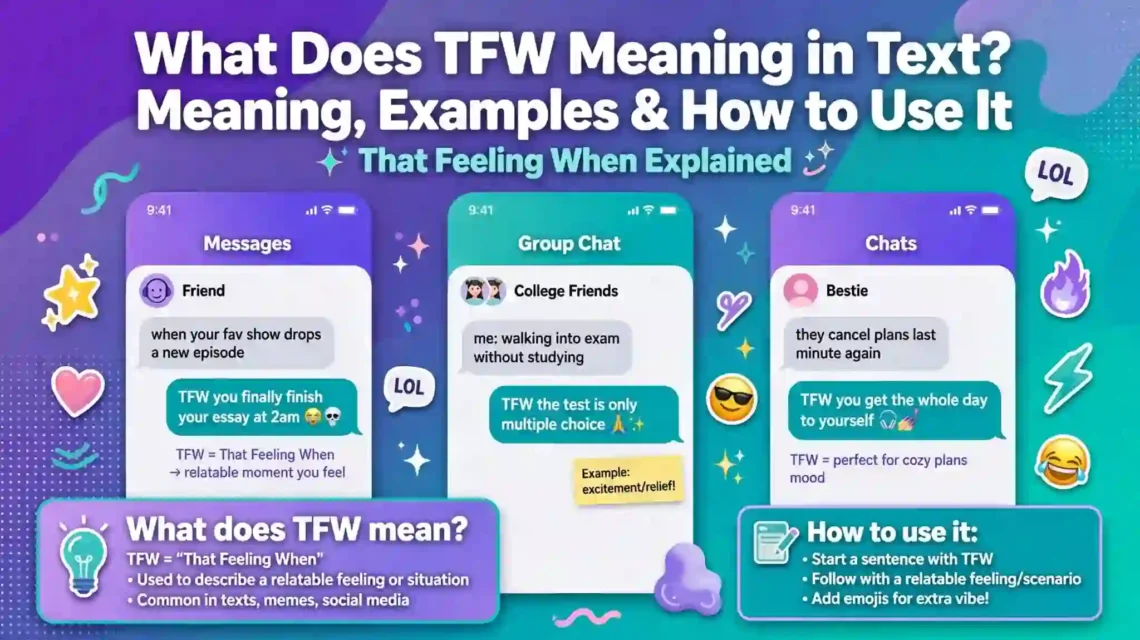
TFW usually means “That Feeling When.” It introduces a situation that creates a strong or relatable emotion. People often use it to share moments that others may understand from personal experience.
For example:
- “TFW you finish all your work early.”
- “TFW your favorite song starts playing.”
- “TFW you see your crush online.”
- “TFW you forget why you entered a room.”
- “TFW the weekend finally arrives.”
Each example describes a situation and the feeling that comes with it. The sender does not need to explain the emotion in detail. The reader can often understand it from the context.
You may also see TFW expanded as “That Feel When.” This version has a more casual, internet-style tone. Both forms communicate the same basic idea.
What Does Each Letter in TFW Stand For?
The abbreviation uses the first letter of each word in the phrase “That Feeling When.”
- T: That
- F: Feeling
- W: When
Some people write “That Feel When” instead. The wording changes slightly, but the purpose stays the same.
The phrase introduces a moment that causes a particular emotion. It often appears before a short sentence or description.
For example, “TFW your phone battery lasts all day” describes the satisfaction of having enough battery power. The abbreviation sets up the feeling. The words that follow explain the situation.
Is TFW a Slang Term or an Acronym?
TFW is an internet abbreviation that people often treat as slang. It comes from online communication, where users shorten common expressions to make posts quick and easy to read.
It is also an initialism because people form it from the first letters of several words. Most users say the letters separately rather than pronouncing them as one word.
You can find it in:
- Text messages.
- Social media captions.
- Online comments.
- Memes.
- Forums and discussion boards.
- Gaming chats.
TFW is informal. It usually fits casual conversations better than professional writing.
TFW Meaning in Texting and Online Chats
The TFW meaning in text stays close to its original idea: describing a feeling connected to a particular moment. People use it to make everyday experiences sound funny, emotional, or relatable.
The abbreviation can introduce both positive and negative situations. It does not have one fixed emotion. The rest of the message gives it meaning.
Here are some common examples:
| Text message | Feeling described |
| TFW you get good news | Happiness or excitement |
| TFW you miss someone | Sadness or longing |
| TFW you send a message to the wrong person | Embarrassment |
| TFW your food arrives | Excitement or satisfaction |
| TFW you remember an old memory | Nostalgia |
| TFW nobody understands your joke | Frustration |
The abbreviation works because people often share similar experiences. A short description can make someone laugh or remind them of a moment from their own life.
TFW in Casual Conversations
Friends may use TFW to describe small events from their daily lives. It can make a simple message more expressive.
For example:
Friend 1: “TFW you wake up five minutes before your alarm.”
Friend 2: “Best feeling ever!”
The first person describes a pleasant surprise. The second person understands the feeling and responds naturally.
Another example:
Friend 1: “TFW you study all night and the exam asks something you never read.”
Friend 2: “That is the worst!”
Here, the abbreviation introduces frustration. Both people understand the situation without a long explanation.
TFW in Group Chats
Group chats often include jokes, shared memories, and everyday updates. TFW can help someone describe a situation that everyone in the group knows.
For example:
- “TFW we all agree to meet at 7 but nobody arrives on time.”
- “TFW the group chat becomes active after midnight.”
- “TFW someone says they are five minutes away.”
- “TFW everyone forgets the plan.”
These messages can create a shared joke. They work best when the group understands the situation.
tfw meaning in text in Private Messages
A person may also use the abbreviation in a direct message. It can help them express an emotion without making the conversation too serious.
For example:
“TFW I see your name pop up on my phone.”
This could express happiness or excitement. The meaning may feel romantic if the sender is talking to someone they like.
A different message can communicate sadness:
“TFW you remember someone who is no longer around.”
The expression does not decide the emotion. The situation and relationship give the message its tone.
How Is tfw meaning in text Used on Social Media?
Social media users often share short thoughts, images, and videos about everyday experiences. TFW works well in this format because it introduces a feeling in only three letters.
People use it in captions, comments, memes, and posts. A relatable situation can help others connect with the content.
TFW Meaning in text on Instagram
Instagram users may add TFW to captions, Reels, or comments. It often appears before a description of a funny or emotional moment.
Examples include:
- “TFW your vacation finally begins.”
- “TFW you find the perfect outfit.”
- “TFW your favorite person likes your picture.”
- “TFW the coffee tastes just right.”
- “TFW you get the perfect sunset photo.”
An Instagram caption may also include a photo or video that shows the emotion. The text gives the post extra context.
For example, someone may share a picture of a clean room with the caption, “TFW you finally finish cleaning.” The image supports the message and makes the experience easier to understand.
TFW Meaning in text on TikTok
TikTok creators often use short text overlays to describe relatable situations. TFW can introduce a moment shown in a video.
For example, a creator might show themselves dancing after receiving good news. The text could say:
“TFW you get the job you wanted.”
Another video might show someone looking confused after forgetting what they wanted to say.
“TFW your mind goes blank during a conversation.”
The abbreviation helps viewers understand the joke or emotion before the clip ends. It can also make a video feel more familiar to people who have experienced the same situation.
TFW Meaning in text on Snapchat
Snapchat messages and Stories often use casual language. People may add TFW to a picture, short video, or direct message.
Examples include:
- “TFW school is finally over.”
- “TFW your favorite person sends a snap.”
- “TFW you find money in an old jacket.”
- “TFW you get home after a long day.”
The abbreviation gives a quick description of the feeling behind the snap. Friends can respond with a joke, an emoji, or a similar experience.
TFW meaning in text in Memes and Online Communities
Memes helped make this expression familiar across internet culture. Many memes describe a common experience and connect it with a funny image or reaction.
A typical format starts with TFW and describes a situation. The image then shows the emotion.
For example:
- “TFW you wave at someone who wasn’t waving at you.”
- “TFW the waiter brings your food.”
- “TFW you remember an embarrassing moment from years ago.”
- “TFW you find out tomorrow is a holiday.”
Online communities may use the abbreviation in posts about gaming, school, work, relationships, hobbies, and daily life.
The humor often comes from recognition. Readers laugh because they have experienced something similar.
TFW vs. Similar Internet Abbreviations
Many online abbreviations describe emotions, reactions, or familiar situations. Some look similar, but each one serves a different purpose.
Understanding these differences can help you use them correctly.
TFW vs. MFW
MFW stands for “My Face When.” People use it to describe the facial expression they make in response to a situation.
For example:
“MFW the teacher announces a surprise test.”
The message focuses on the person’s reaction or facial expression.
TFW stands for “That Feeling When.” It focuses more broadly on the emotion connected to a situation.
For example:
“TFW the teacher cancels the test.”
Both expressions can appear in memes. However, MFW often works best when an image shows a facial reaction.
TFW vs. IYKYK
IYKYK means “If You Know, You Know.” People use it when a message refers to an experience or inside joke that only certain readers understand.
For example:
“Those late-night study sessions. IYKYK.”
TFW introduces a feeling connected to a situation. IYKYK suggests that the reader needs shared knowledge to understand the reference.
TFW vs. POV
POV stands for “Point of View.” It often introduces a scene from a particular person’s perspective.
For example:
“POV: You arrive at school just before the bell rings.”
TFW describes the feeling linked to a moment:
“TFW you arrive just before the bell rings.”
The two can appear in similar social media posts, but they serve different purposes.
TFW vs. FR
FR means “For Real.” People use it to show agreement, sincerity, or emphasis.
For example:
“FR, that movie was amazing.”
TFW introduces an experience or emotion. FR reacts to a statement or confirms that someone agrees.
TFW vs. Mood
Mood is a casual way to show that something reflects your current feelings or personality.
For example:
“Staying in bed all day. Mood.”
TFW usually introduces a specific situation that causes a feeling. Mood can simply label a feeling or attitude.
How to Reply When Someone Uses TFW
Your reply depends on the situation. The sender may be sharing a joke, expressing sadness, or describing an exciting moment.
A good response shows that you understand the feeling.
Friendly Replies
Use these replies when a friend shares a familiar or relatable experience:
- “I know that feeling!”
- “Same here!”
- “That happens to me too.”
- “I can totally relate.”
- “So true!”
- “Been there!”
- “That’s exactly how I feel.”
Funny Replies
A humorous response can keep the conversation light.
- “Why is this so accurate?”
- “This is literally me.”
- “Too real!”
- “I feel personally attacked.”
- “We all know that moment.”
- “Not me doing the same thing!”
- “This deserves an award.”
Supportive Replies
If the message describes a difficult emotion, respond with care.
- “I understand. That must be hard.”
- “I’m here if you want to talk.”
- “I hope things get better.”
- “You’re not alone.”
- “Sending you a big hug.”
- “I know how much that can hurt.”
Romantic Replies
If someone uses the expression in a sweet message, you can respond warmly.
- “I get that feeling with you.”
- “You make those moments special.”
- “That’s exactly how I feel.”
- “You always make me smile.”
- “I love those little moments too.”
You do not need to copy the abbreviation in your reply. A natural response is usually better than forcing slang into every message.
Common Mistakes to Avoid When Using TFW
Even simple abbreviations can cause confusion when people use them without understanding their purpose. A few small details can help you communicate more clearly.
Thinking TFW Has Only One Exact Expansion
“That Feeling When” is the common expansion. You may also see “That Feel When.” Both versions introduce a relatable situation.
Do not assume every user follows the same wording. The intended message matters more than the exact expansion.
Using It Without Describing a Situation
TFW usually introduces a moment or experience. Writing only “TFW” may leave the reader wondering what you mean.
Add a short description to make the message clear.
For example:
- Less clear: “TFW.”
- Clearer: “TFW you find your lost keys.”
Confusing It With MFW
TFW and MFW have related uses, but they are not identical. TFW focuses on a feeling. MFW focuses on a facial reaction.
Choose the one that matches your message.
Using It in Formal Writing
TFW belongs to casual internet language. It may confuse readers in a business report, formal email, or academic assignment.
Use complete sentences in professional settings. Clear wording is more useful than an abbreviation your audience may not know.
Ignoring the Context
A message can express happiness, sadness, frustration, or humor. Never assume the emotion from the abbreviation alone.
Read the words after TFW. Look at the image or video if the sender shares one. This helps you understand the intended meaning.
Tips for Using TFW Naturally
You can use this abbreviation in many casual conversations. The key is to make sure it fits the situation and sounds natural.
- Describe a relatable moment: Choose a situation your audience can understand.
- Keep the message short: A simple sentence often works best.
- Match the emotion: Use it for funny, happy, awkward, or emotional experiences.
- Add an image when useful: A photo or meme can make the feeling clearer.
- Know your audience: Friends may understand internet slang, while formal contacts may not.
- Avoid overusing it: Use the abbreviation when it adds meaning.
- Read the room: A joke may not fit a serious or sensitive conversation.
A simple example is “TFW you finally get a full night of sleep.” Most people can understand the feeling without further explanation.
The best use of internet slang is natural and clear. You do not need to use every popular abbreviation to take part in online conversations.
FAQs About TFW Meaning in Text
1. What Does TFW Stand for in Texting?
TFW usually stands for “That Feeling When.” It introduces a situation that creates a particular emotion. People use it in texts, captions, comments, and memes.
2. Does TFW Mean That Feel When?
Yes. Some people expand TFW as “That Feel When” instead of “That Feeling When.” Both expressions introduce a relatable experience and communicate the same general idea.
3. What Does TFW Mean on Instagram?
On Instagram, TFW usually introduces a feeling connected to a photo, Reel, caption, or comment. Users often add it to funny, emotional, or relatable posts.
4. What Does TFW Mean on TikTok?
On TikTok, TFW introduces a situation shown in a video. Creators may use it in text overlays or captions to describe a funny or familiar experience.
5. Is TFW Still Used in Online Conversations?
Yes. People still use TFW in internet posts, memes, and casual messages. Its popularity may vary between communities, but readers can often understand it from context.
6. How Should I Reply to TFW?
You can reply with “I know that feeling,” “Same here,” or “That’s so relatable.” Choose a response that matches the emotion in the original message.
Final Thoughts
Understanding TFW meaning in text helps you follow casual chats, social media captions, and internet memes. The abbreviation usually stands for “That Feeling When” or “That Feel When.” People use it to introduce a moment that creates a familiar emotion.
It can describe happiness, excitement, sadness, embarrassment, frustration, or romance. The words after the abbreviation explain the situation. A picture or video can add even more meaning.