
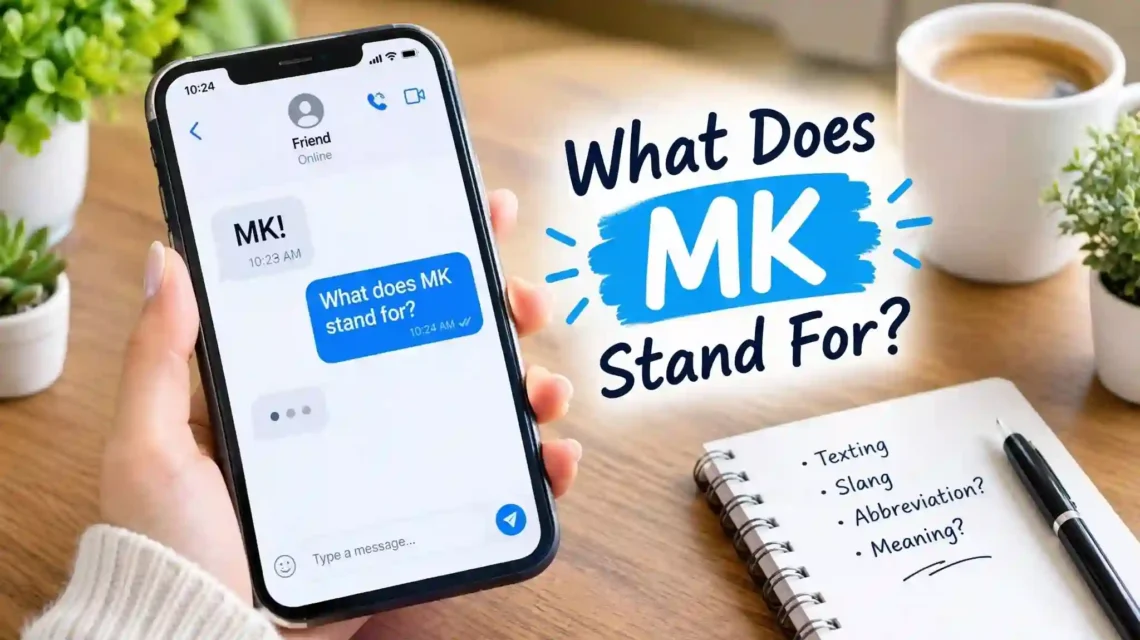
When it comes to mk meaning in text, the short answer is simple: “MK” usually means “okay.” People use it in text messages, chats, social media, and online conversations to show agreement or acknowledgment. However, the exact tone can change based on the conversation.
For example, someone may send “mk” as a quick way to say “okay,” while another person may use it when they feel annoyed, tired, or uninterested. That is why context matters when you receive this abbreviation.
MK Meaning in Text: The Basic Definition
The most common mk meaning in text is “okay.” It is a short, casual response that tells another person you understand or accept what they said.
You may see MK in many everyday conversations. A friend might text “mk, see you later,” or someone may reply “mk” after receiving simple instructions.
In most cases, MK does not carry a complicated meaning. It simply saves time and space. Like many texting abbreviations, its meaning depends partly on the words around it and the relationship between the people chatting.
What Does MK Stand For?
MK generally stands for “okay” in casual digital communication. Some people may also interpret it as a shortened form of “mm, okay,” but “okay” remains the common interpretation.
The abbreviation works because texting often favors short responses. People may remove extra letters or sounds while keeping the main idea clear.
For example:
- “MK, I’ll be there.”
- “MK, sounds good.”
- “MK, I understand.”
- “MK, no problem.”
- “MK, talk later.”
Each example communicates acknowledgment. The sender does not need to type the full word “okay.”
Is MK a Slang Word?
MK can be considered a casual texting abbreviation rather than traditional slang. It appears mainly in informal digital conversations.
You are more likely to see it in:
- Text messages
- Group chats
- Social media messages
- Gaming chats
- Casual online conversations
- Comments and replies
It is usually not suitable for formal writing. In a school essay, business report, or professional letter, writing “okay” or “understood” is clearer.
MK Meaning in Text Messages and Chats
In text messages, mk meaning in text often depends on the sender’s tone, punctuation, and the situation. A simple “mk” can sound neutral, friendly, impatient, or slightly cold.
Consider these examples:
Person A: “I’ll call you after dinner.”
Person B: “mk”
Here, the response probably means “okay.” It confirms that the message was received.
Now consider:
Person A: “Please remember to bring my book tomorrow.”
Person B: “mk.”
The period may make the response feel more firm or serious. The word itself has not changed, but the punctuation can affect how the message feels.
Another example:
Person A: “Do you want pizza?”
Person B: “mk :)”
The smiley face makes the reply feel warmer and more relaxed.
This shows why you should avoid judging a short message by the abbreviation alone.
MK in Friendly Conversations
Friends often use MK because they already understand each other’s communication style. The abbreviation can make a conversation feel quick and informal.
For example:
“Meet me outside at 7.”
“mk”
The response simply confirms the plan.
Another example:
“I’ll send you the notes tonight.”
“mk, thanks!”
Here, MK works as a quick acknowledgment before the person adds appreciation.
MK in Casual Conversations
People may also use MK when they want to move a conversation forward without repeating a full response.
For example:
“Don’t forget your charger.”
“mk”
The sender understands the reminder and does not need to provide a detailed answer.
This is especially common when the information is simple and does not require discussion.
What Does MK Mean in Different Contexts?
The meaning of MK can remain “okay,” but its emotional tone may change from one conversation to another. Context is the key factor.
MK as Agreement
Sometimes MK clearly means that the sender agrees with a suggestion or plan.
Example:
“Let’s meet at 6 instead.”
“mk”
Here, MK means something close to “Okay, that works.”
MK as Acknowledgment
MK can simply show that the person received and understood information.
Example:
“Your appointment is tomorrow at 10.”
“mk”
The sender may not be expressing excitement or enthusiasm. They are simply confirming that they understand.
MK as Acceptance
A person may use MK to accept a request.
Example:
“Can you send me the file later?”
“mk”
In this case, the response means “Okay, I can do that.”
MK as a Short or Dry Response
Sometimes MK may feel less enthusiastic than a longer response such as “Okay, sounds good!”
For example:
“I got us tickets for Saturday!”
“mk”
Depending on the relationship and previous conversation, this could feel unusually brief.
However, you should not automatically assume the sender is angry. They may simply be busy, distracted, or naturally brief when texting.
Does MK Mean “Okay” or Something Else?
For most casual text conversations, MK means “okay.” Still, abbreviations can have different meanings in specialized settings.
The surrounding conversation should guide your interpretation. If someone sends only “MK,” look at what was said immediately before it.
For example:
“Can you meet me at 5?”
“MK.”
This almost certainly means “okay.”
But if the conversation involves a person’s initials, a product name, a place, or another specific topic, MK could have a different meaning. Acronyms can represent names, organizations, technical terms, or other phrases.
Therefore, context is more reliable than assuming every use of MK has the same definition.
Is MK Rude in a Text?
MK is not automatically rude. Its tone depends on context, relationship, punctuation, and the rest of the conversation.
A short reply can feel rude when someone expects a more detailed or emotional response.
For example:
“I worked really hard on this project. What do you think?”
“mk”
This reply might feel dismissive because the situation calls for more engagement.
But consider:
“I’ll send the document tonight.”
“mk”
That response is perfectly normal because the message only needs acknowledgment.
Why MK Can Sound Cold
Texting removes many cues that people use in face-to-face conversations. You cannot hear the sender’s voice or see their facial expression.
As a result, a very short response can leave room for interpretation.
MK may seem cold when:
- The previous message was emotional.
- The sender normally writes longer replies.
- The conversation involved an argument.
- The person uses punctuation that feels serious.
- The response arrives after a long silence.
- The message ignores an important question.
Still, these clues do not prove that the person is angry or upset. It is better to consider the full conversation.
How to Reply to MK in a Text
Your reply should depend on what the other person said before sending MK. If they simply acknowledge your message, you may not need to respond at all.
If you want to continue the conversation, you can use a natural reply.
Casual Replies
For a simple conversation, try:
- “Cool!”
- “Sounds good.”
- “Okay!”
- “Perfect.”
- “Thanks!”
- “See you then.”
- “Awesome.”
For example:
You: “I’ll meet you outside at 7.”
Them: “MK.”
You: “Sounds good!”
You do not need to overthink a short acknowledgment.
Friendly Replies
If you want to keep the conversation warm, add a little personality.
Examples include:
- “Awesome 😊”
- “Perfect, see you soon!”
- “Great, thanks!”
- “Cool, talk later!”
- “Sounds good to me!”
These replies work well with friends, classmates, and people you know casually.
When You Are Unsure About Their Tone
If MK seems unusually short, avoid immediately assuming something is wrong.
You can ask:
- “Everything okay?”
- “All good?”
- “You seem quiet. Everything alright?”
- “Did I bother you?”
Use these questions only when the broader conversation gives you a reason to think something may be wrong.
Examples of MK in Text Conversations
Seeing the abbreviation in real conversations makes its meaning easier to understand.
Example 1: Making Plans
Alex: “Want to grab coffee tomorrow?”
Sam: “Sure. Around 4?”
Alex: “MK, 4 works.”
Here, MK means “okay.”
Example 2: Confirming Information
A: “The meeting starts at 9 AM.”
B: “MK, thanks for letting me know.”
The sender uses MK to acknowledge the information.
Example 3: Accepting a Request
A: “Can you bring my notebook?”
B: “MK.”
The response means “okay” or “sure.”
Example 4: Ending a Conversation
A: “I need to sleep now. Talk tomorrow.”
B: “MK, goodnight.”
Here, MK helps acknowledge the message before ending the conversation.
Common Mistakes When Interpreting MK
One common mistake is treating every short response as a sign of anger. Text messages often lack the emotional information available in face-to-face conversations.
Another mistake is assuming that the abbreviation always has one fixed emotional meaning.
Avoid these assumptions:
Mistake 1: Assuming MK Is Always Rude
A short message is not automatically rude. Some people naturally use brief responses.
Mistake 2: Ignoring the Conversation
Always read the messages before and after MK. The surrounding context often explains the intended tone.
Mistake 3: Overanalyzing Punctuation
A period can sometimes make a short message feel more serious, but punctuation alone does not prove emotion.
Mistake 4: Confusing MK With Every Possible Acronym
MK can have meanings outside texting. If the context is specialized, check what the abbreviation refers to before deciding what it means.
How Tone Changes the Meaning of MK
Tone is one of the most important parts of digital communication. The same two letters can feel different depending on how they appear.
Compare these messages:
Can sound more firm or serious.
Can sound more firm or serious.
May feel more serious or firm.
“mk lol”
Usually casual and playful.
These are not strict rules. People have different texting habits. One person’s normal punctuation may feel unusual to another person.
The safest approach is to consider the sender’s usual style.
When Should You Use MK?
MK works best in informal communication where the other person understands casual texting abbreviations.
Good situations include:
- Chatting with friends
- Talking with classmates
- Casual group messages
- Social media conversations
- Gaming chats
- Informal online discussions
Avoid relying on MK in situations where clarity and professionalism matter.
For example, in a formal email, you could write:
“Okay, I understand. Thank you.”
Instead of:
“MK.”
The longer version clearly communicates your meaning and fits a professional setting better.
Why People Use Short Text Abbreviations
Text abbreviations developed from the need for quick, efficient digital communication. Early texting encouraged short messages, and online chat later helped spread many informal shortcuts.
Today, people use abbreviations for several reasons.
Speed
Typing “mk” takes less effort than typing “okay.” The difference is small, but people often use shortcuts naturally during fast conversations.
Convenience
Short responses are useful when the message only needs acknowledgment.
Informal Tone
Abbreviations can make a conversation feel relaxed. Friends may use them because they match the style of everyday chatting.
Personal Writing Style
Some people prefer short messages. Others use emojis, GIFs, slang, or complete sentences. Texting style varies from person to person.
Should You Reply to MK?
You do not always need to reply. If MK simply confirms that someone received your information, the conversation may naturally end there.
For example:
You: “I’ll be there at 6.”
Them: “MK.”
The exchange is complete.
However, if you want to continue the conversation, you can add a relevant response.
For example:
“MK.”
“Great! See you at 6.”
The right choice depends on whether the conversation still needs an answer.
Frequently Asked Questions
What does MK mean in texting?
The common mk meaning in text is “okay.” People use it as a short acknowledgment, agreement, or acceptance in casual conversations.
Is MK short for “okay”?
Yes. In casual texting, MK commonly works as a shortened form of “okay.” It can confirm that someone understands or accepts what another person said.
Is MK rude in a text message?
MK is not inherently rude. It can sound brief or slightly cold in some situations, especially when a longer response would normally be expected, but context matters.
What should I reply when someone texts MK?
You can reply with “sounds good,” “okay,” “perfect,” “thanks,” or another response that matches the conversation. If no further response is needed, you can also leave it there.
What is the difference between MK and K?
Both can mean “okay,” but K is often shorter and may feel more abrupt. MK can sound slightly more conversational, although individual texting habits vary.
Can MK have other meanings?
Yes. Abbreviations can represent different words or names in specialized contexts. In ordinary texting, however, “okay” is the common interpretation.
Conclusion
Understanding mk meaning in text is usually straightforward because MK commonly means “okay.” People use it to acknowledge information, agree with a plan, accept a request, or keep a casual conversation moving.
The important part is tone. A simple “mk” may sound friendly and normal between close friends. In another conversation, the same reply may feel short or distant. Punctuation, emojis, previous messages, and the sender’s usual texting style can all affect how it feels.