
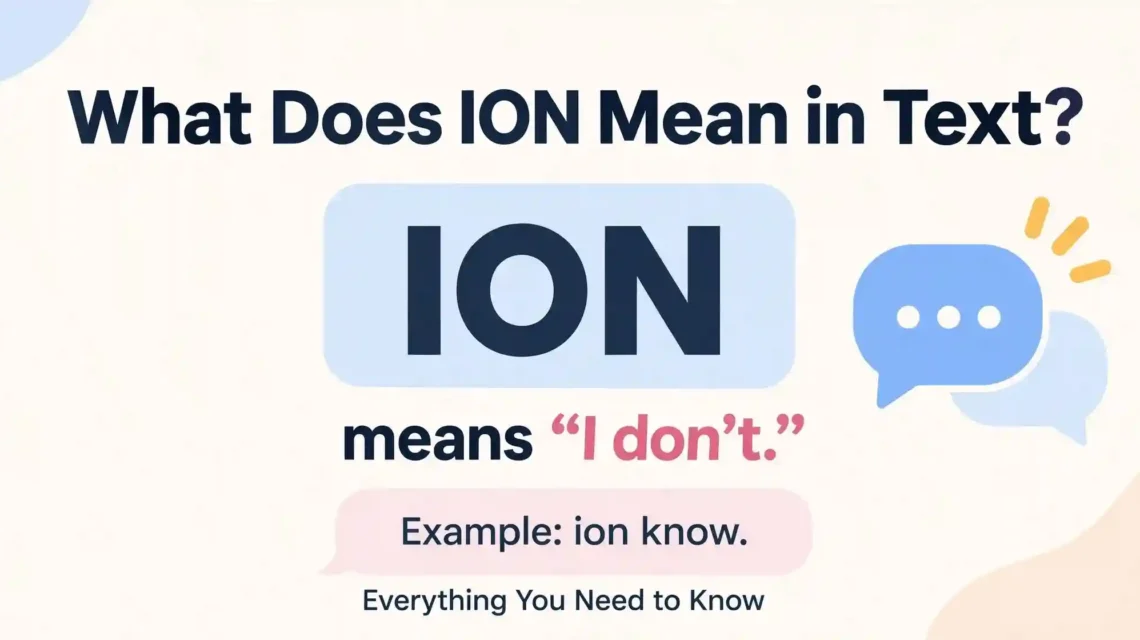
When it comes to ion meaning in text, the word can look confusing at first. You may see someone write “ion know,” “ion care,” or “ion wanna go” and wonder whether it has a special meaning. In casual texting, ion commonly works as an informal way to write “I don’t.” It reflects the sound of the phrase in relaxed speech and appears often in social media posts, comments, and private messages.
What Does ION Meaning in Text?
The simplest ion meaning in text is usually “I don’t.” People use it as casual slang when they want to express a negative statement without typing the full phrase.
For example:
- “Ion know.” = “I don’t know.”
- “Ion care.” = “I don’t care.”
- “Ion want that.” = “I don’t want that.”
- “Ion think so.” = “I don’t think so.”
- “Ion like it.” = “I don’t like it.”
The word normally appears before another word or phrase. That makes the intended meaning easier to understand.
Unlike standard abbreviations such as “IDK” or “BTW,” “ion” is closer to a phonetic spelling. It represents the way “I don’t” may sound when spoken quickly and casually.
Why Do People Write “Ion”?
People use slang like “ion” because online communication often favors speed, personality, and conversational style. Typing “ion” can make a message feel more relaxed and closer to spoken conversation.
It can also give a message a particular social or cultural tone. Informal spellings are common across online communities, and their meaning often depends on the people using them.
For instance, compare these messages:
- “I don’t know.” — Standard and neutral.
- “I don’t know lol.” — Casual.
- “Ion know lol.” — Very informal and conversational.
All three can communicate the same basic idea, but the tone can feel different.
“Ion Know” Meaning
“Ion know” is one of the easiest examples to understand. It means “I don’t know.”
Someone might text:
“What time does the store close?”
You could receive:
“Ion know.”
The person is simply saying that they do not know the answer.
The phrase can also appear in longer sentences:
- “Ion know what happened.”
- “Ion know where she went.”
- “Ion know if I can come.”
- “Ion know what you mean.”
The tone can range from completely neutral to playful, depending on the conversation.
“Ion Care” Meaning
“Ion care” means “I don’t care.” However, this phrase deserves extra attention because it can sound blunt.
For example:
“Do you want pizza or burgers?”
Someone might reply:
“Ion care.”
That could mean they are genuinely happy with either choice.
But during an argument, the same phrase may sound dismissive:
“Everyone is talking about what you did.”
“Ion care.”
Here, the sender may be showing indifference or refusing to engage.
So, the words alone do not always tell you the entire tone. Emojis, punctuation, previous messages, and the relationship between the speakers can all affect how the message feels.
How to Understand ION in Different Contexts
Context plays an important role because “ion” does not have only one possible interpretation. In casual slang, it often means “I don’t,” but ION can also function as an acronym for “In Other News.”
The easiest way to determine the intended meaning is to examine what comes immediately after it.
When “Ion” Means “I Don’t”
Look for a sentence where “I don’t” makes grammatical sense.
Examples include:
- “Ion wanna leave.”
- “Ion remember.”
- “Ion believe you.”
- “Ion see anything.”
- “Ion need help.”
In each case, replacing “ion” with “I don’t” creates a normal sentence.
When “ION” Means “In Other News”
Sometimes ION is used as an acronym for “In Other News.” In this use, it usually introduces a new topic or shifts the conversation.
For example:
“The meeting was exhausting. ION, did you finish that new series?”
Here, “ION” does not mean “I don’t.” The writer is moving from one subject to another.
Another example:
“I finally finished my homework. ION, are you going out tonight?”
The topic changes after the acronym.
A Simple Context Test
Use these three questions:
- Does “I don’t” fit the sentence?
- Does the word introduce a completely new topic?
- Is the conversation casual or technical?
If “I don’t” fits naturally, the slang interpretation is likely.
If the writer uses “ION” to jump to another subject,
“In Other News” may be intended.
If you are reading a chemistry lesson, the word probably has its scientific meaning instead.
ION Meaning in Text: Examples You Can Easily Understand
Learning slang becomes easier when you see it in realistic conversations. The following examples show how the word can appear in different situations.
Example 1: Not Knowing Something
Person A: “Where did Jake go?”
Person B: “Ion know.”
Meaning:
“I don’t know.”
The speaker simply does not have the information.
Example 2: Refusing an Invitation
Person A: “You coming to the party?”
Person B: “Ion wanna go tonight.”
Meaning:
“I don’t want to go tonight.”
Here, “ion” expresses a personal choice.
Example 3: Showing Indifference
Person A: “Should we order pizza or tacos?”
Person B: “Ion care. You choose.”
Meaning:
“I don’t care. You choose.”
In this situation, the speaker may genuinely have no preference.
Example 4: Disagreeing
Person A: “That movie was amazing.”
Person B: “Ion think it was that good.”
Meaning:
“I don’t think it was that good.”
Here, “ion” introduces a disagreement.
How to Reply When Someone Says “ION”
Knowing ion meaning in text is only half the problem. You may also wonder how to respond when someone uses it in a message.
The best reply depends on the sentence.
If They Say “Ion Know”
You can provide the missing information.
Them: “Ion know what time it starts.”
You: “It starts at 7.”
Or you can respond casually:
“Same, let’s check.”
If They Say “Ion Care”
Do not automatically assume they are being rude. Look at the context.
Them: “Pizza or burgers?”
You: “Pizza it is 😂”
If the phrase appears during an argument, you may want to clarify:
“Okay, but I’m asking because I want to know what you think.”
If They Say “Ion Wanna Go”
You can respect their decision or ask why.
Possible replies include:
- “No worries.”
- “That’s fine.”
- “Why not?”
- “Maybe another time.”
- “All good.”
Your response should match the relationship and situation.
If They Say “Ion Think So”
This usually signals disagreement or uncertainty.
You could reply:
- “Why not?”
- “What makes you think that?”
- “Fair enough.”
- “I guess we’ll see.”
The important thing is to respond to the actual message rather than focusing only on the slang.
Is “ION” Rude?
The word itself is not automatically rude. Its tone depends on the sentence, situation, and relationship between the people talking.
For example:
“Ion know 😂”
may sound relaxed or playful.
But:
“Ion care.”
can sound dismissive, especially during a disagreement.
Likewise:
“Ion wanna go, sorry.”
sounds softer than:
“Ion wanna go. Stop asking.”
The second message feels more direct because of the additional wording.
Factors That Affect the Tone
Consider:
- The topic: Serious conversations can make short slang replies feel harsher.
- Punctuation: A short sentence ending with a period can sometimes feel more final.
- Emojis: Emojis may soften or change the mood.
- Relationship: Close friends may use blunt slang without intending offense.
- Previous messages: An argument can make a neutral phrase sound aggressive.
Never judge the tone from “ion” alone.
Where Is ION Commonly Used?
The slang appears in informal digital communication, including text messages, social media comments, direct messages, and online conversations. Sources describing the term note its use across platforms such as X, TikTok, and Instagram.
You may encounter it in:
- Text messages
- Group chats
- Instagram DMs
- TikTok comments
- X posts and replies
- Snapchat conversations
- Gaming chats
- Informal online communities
The exact frequency varies by community and individual writing style.
Is It Appropriate for Work?
Usually, it is better to avoid “ion” in professional communication.
For example, instead of:
“Ion know when the report is due.”
write:
“I don’t know when the report is due.”
Professional writing benefits from clarity and standard grammar. Slang can be suitable with friends but may look overly casual in an email to a manager, client, teacher, or business contact.
Common Mistakes People Make With ION
Understanding the slang is easy once you know the pattern, but several mistakes can cause confusion.
Mistake 1: Assuming It Always Means “In Other News”
Some people recognize “ION” only as an acronym. In many casual texting contexts, however, lowercase “ion” is used to represent “I don’t.”
Always examine the sentence before choosing a definition.
Mistake 2: Assuming It Means “I Don’t Know”
“Ion” does not always mean “I don’t know.”
For example:
“Ion care.”
means:
“I don’t care.”
And:
“Ion want it.”
means:
“I don’t want it.”
The word “ion” generally represents “I don’t,” while the next word completes the thought.
Mistake 3: Using It in Formal Writing
Slang can make a professional message seem too casual.
Instead of:
“Ion have the file.”
use:
“I don’t have the file.”
Clear language is usually the better choice in formal situations.
Mistake 4: Assuming Someone Is Rude
A message like “ion know” does not necessarily show a bad attitude. It may simply reflect the person’s normal texting style.
Look at the whole conversation before deciding what the sender intended.
What Does ION Mean in Chemistry?
Outside texting, ion has a completely different scientific meaning. In chemistry, an ion is an atom or group of atoms that carries an electrical charge because it has gained or lost electrons.
For example:
- A positively charged ion is called a cation.
- A negatively charged ion is called an anion.
So, the meaning depends heavily on context.
Consider these two sentences:
“Ion know what happened.”
This is texting slang and means “I don’t know what happened.”
Now compare:
“A sodium ion has a positive charge.”
This is a chemistry statement. Here, “ion” has its standard scientific meaning.
The spelling is identical, but the context makes the difference clear.
How to Know Which Meaning Someone Intended
When you see “ion,” you do not need to guess immediately. A quick context check can usually solve the problem.
Step 1: Look at the Words After “Ion”
If you see:
- ion know
- ion care
- ion want
- ion like
- ion think
try replacing “ion” with “I don’t.”
If the sentence works, you have probably found the intended meaning.
Step 2: Check the Conversation
Ask what the person was discussing.
A TikTok comment is much more likely to use slang than a chemistry textbook.
Step 3: Look for a Topic Change
If “ION” appears as a transition before a new subject, it may mean “In Other News.”
For example:
“That exam was stressful. ION, did you watch the game?”
Here, the writer clearly shifts topics.
Step 4: Consider the Setting
The platform and audience provide useful clues.
A casual DM between friends allows much more slang than a formal email.
Should You Use ION in Your Own Texts?
You can use it if it fits your usual communication style and the people you are talking to understand it.
It works well in casual settings such as:
- Friends
- Close family members
- Informal group chats
- Social media
- Casual gaming conversations
Avoid it when clarity and professionalism matter most.
When “ION” Works Well
For example:
“Ion wanna go out tonight lol.”
This sounds natural in an informal chat.
When Standard English Works Better
For example, in a work email:
“I don’t want to attend the meeting today.”
That version is clearer and more professional.
The goal is not to decide that slang is good or bad. The goal is to choose language that fits the audience.
Frequently Asked Questions About ION
What does ION mean in text?
In casual texting, “ion” commonly means “I don’t.” It is an informal spelling used in phrases such as “ion know,” “ion care,” and “ion want to go.” Context can also give ION other meanings.
What does “ion know” mean?
“Ion know” means “I don’t know.” It is a casual way to express uncertainty or say that you do not have the requested information.
Is ION the same as “I don’t”?
In many informal text messages, yes. “Ion” can act as a phonetic or slang form of “I don’t.” However, the intended meaning should always be confirmed through context.
What does “ion care” mean?
“Ion care” means “I don’t care.” Depending on the situation, it can express genuine indifference, a lack of preference, or a more dismissive attitude.
Can ION mean “In Other News”?
Yes. ION can also stand for “In Other News.” This use usually appears when someone wants to shift the conversation to another subject.
Is ION appropriate in formal writing?
Generally, no. It is best suited to casual texts, social media, and informal chats. In professional, academic, or official writing, use standard phrases such as “I don’t” instead.
Conclusion
Understanding ion meaning in text becomes simple once you look at the words and context around it. In casual online communication, “ion” commonly means “I don’t.” You may see it in phrases such as “ion know,” “ion care,” “ion want,” and “ion think so.”
The term is informal, so it works best in relaxed conversations with people who understand the slang. It is usually not the right choice for formal emails, school assignments, business messages, or professional documents.