
When it comes to texting, short forms can make conversations faster, but they can also confuse people who do not know the latest chat slang. DW meaning in text is usually “Don’t Worry.” People use it to reassure someone, reduce stress, or tell them that a problem is not serious. You may see DW in text messages, social media chats, gaming conversations, and casual online discussions. Its meaning is usually simple, but the tone can change depending on the situation and the relationship between the people talking. In this guide, you will learn what DW means, how people use it, what it means from a guy or girl, when to reply, and which responses sound natural.
What Does DW Meaning in Text?
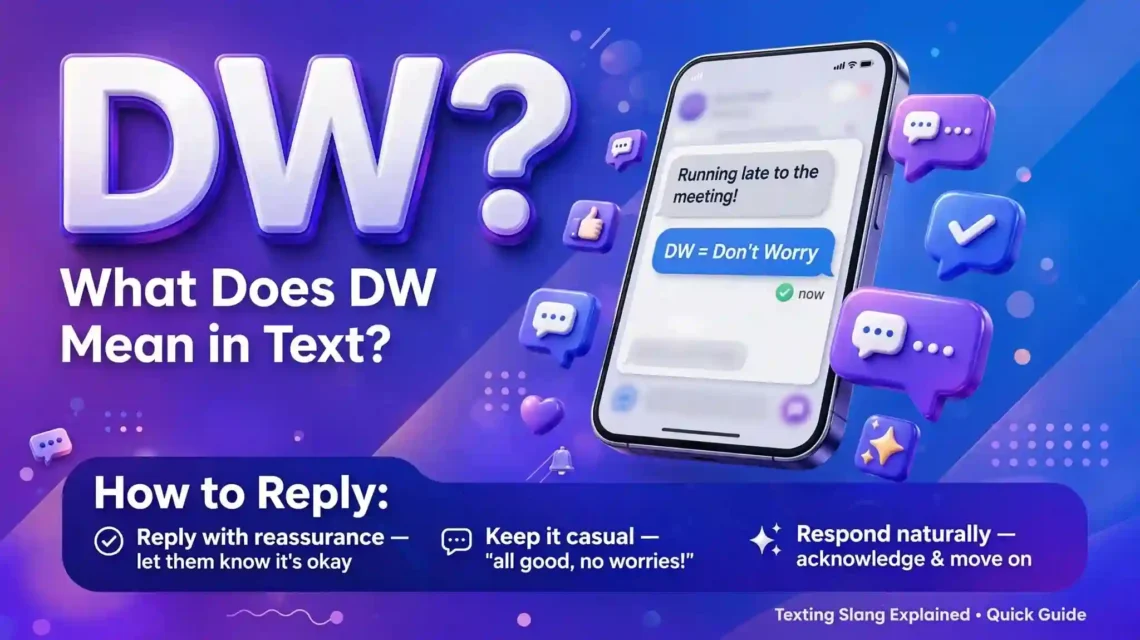
DW is a common texting abbreviation for “Don’t Worry,” and people use it when they want to reassure someone, calm a concern, or show that a situation does not require stress.
The abbreviation saves time and works well in informal conversations. Instead of typing the complete phrase, someone can simply write “DW.”
For example:
Person A: Sorry, I might be five minutes late.
Person B: DW, take your time.
Here, DW means “Don’t worry.” The person is telling the other person that being slightly late is not a problem.
You may also see DW after someone apologizes:
“DW about it.”
This means:
“Don’t worry about it.”
The expression can sound friendly, casual, and reassuring. However, the exact emotional tone depends on the rest of the conversation.
DW Meaning in Text: The Basic Definition
The basic definition is straightforward: DW normally means “Don’t Worry,” especially in casual digital communication between friends, family members, classmates, coworkers, or online contacts.
It often appears when one person thinks the other person feels concerned, guilty, nervous, or uncomfortable.
Common examples include:
- “DW, everything is fine.”
- “DW about the meeting.”
- “DW, I can handle it.”
- “DW, you don’t need to apologize.”
- “DW! It happens.”
- “DW, I’ll let you know later.”
In each example, the abbreviation helps create a relaxed tone.
The phrase can also reduce the pressure of a conversation. If someone says, “I forgot to send the file,” a response such as “DW, send it tomorrow” shows that the mistake is manageable.
Why Do People Use DW Instead of “Don’t Worry”?
People use abbreviations because texting encourages quick communication, especially when a message does not need a formal or detailed response.
Typing “DW” takes less effort than typing “Don’t worry.” It also fits naturally with other common abbreviations such as “BTW,” “IDK,” “LOL,” “TTYL,” and “YW.”
There is another reason people use it: DW feels casual.
Compare these messages:
- “Don’t worry. Everything is okay.”
- “DW, everything’s okay.”
The first can sound more complete or serious. The second usually feels more relaxed and conversational.
This does not mean DW is always better. In professional emails, formal notices, or serious situations, writing the full phrase may communicate more clearly.
How Is DW Used in Text Messages?
DW is mainly used as a reassurance phrase after an apology, concern, mistake, delay, question, or situation that might make someone feel uncomfortable or stressed.
Consider these common situations.
After an Apology
Someone may say:
“Sorry I forgot to call you.”
A natural response could be:
“DW, it’s okay.”
Here, DW communicates forgiveness or reassurance.
When Someone Is Late
A person might text:
“Traffic is bad. I’ll be there soon.”
The reply could be:
“DW, drive safely.”
In this case, DW tells the person not to feel pressured.
After a Small Mistake
Someone may write:
“I accidentally sent the wrong photo.”
The response:
“DW 😂”
can mean that the mistake is not important.
When Someone Is Nervous
For example:
“I’m worried about tomorrow’s presentation.”
A friend might answer:
“DW, you’ll be fine.”
The abbreviation helps create a supportive and informal tone.
When Someone Thinks They Caused a Problem
A person might say:
“I hope I didn’t bother you.”
The response:
“DW, you didn’t.”
Here, DW helps remove the person’s concern.
DW Meaning in Text From a Guy
When a guy sends DW in a conversation, it usually means “Don’t worry,” but the meaning of the message depends more on the surrounding conversation than on the sender’s gender.
For example:
You: Sorry, I can’t come tonight.
Him: DW, maybe next time.
This simply sounds reassuring and friendly.
Another example:
You: I think I made things awkward.
Him: DW about it.
Again, the message most likely means that he does not think the situation is a major issue.
DW by itself does not prove romantic interest, friendship, annoyance, or any other specific emotion. You should look at the entire conversation.
Consider:
- What was said before DW?
- Did the person add emojis?
- Was the conversation serious or playful?
- Do they normally use abbreviations?
- Did they continue the conversation afterward?
- Was DW followed by another sentence?
These details can help you understand the intended tone.
Does DW From a Guy Mean He Likes You?
Not necessarily. DW is a general abbreviation, so it does not automatically indicate romantic interest or attraction.
If a guy writes:
“DW, I got you.”
he may simply be offering reassurance or support.
Likewise:
“DW 😂”
may simply mean that he is keeping the conversation light.
To understand someone’s intentions, focus on the broader pattern of communication rather than interpreting one abbreviation as a hidden romantic signal.
DW Meaning in Text From a Girl
When a girl uses DW, it generally carries the same basic meaning: “Don’t worry.” She may use it to reassure you, dismiss a small concern, or make a casual conversation feel more relaxed.
For example:
You: Sorry for replying so late.
Her: DW, I was busy too.
The message means that she is not upset about the delayed reply.
Another example is:
You: I hope I didn’t make you uncomfortable.
Her: DW, you’re good.
This is a reassuring response.
The sender’s gender does not change the standard meaning of the abbreviation. Context remains the most useful clue.
Does DW From a Girl Mean She Is Interested?
DW alone cannot establish romantic interest. It is a common abbreviation that people use in many types of relationships.
A person might use it with:
- Friends
- Family
- Classmates
- Coworkers
- Online friends
- Romantic partners
- New acquaintances
Therefore, avoid assigning a romantic meaning to DW without other context.
What Does DW Mean on Snapchat, Instagram, and WhatsApp?
On social platforms, DW generally means “Don’t Worry,” just as it does in ordinary text messages.
The platform does not usually change the abbreviation’s standard meaning.
DW on Snapchat
A Snapchat user might write:
“DW, I’ll send it again.”
This means “Don’t worry, I’ll send it again.”
DW on Instagram
In an Instagram direct message, you could see:
“DW about the comment.”
The sender is reassuring you about the comment.
DW on WhatsApp
WhatsApp conversations often contain short forms because people use the app for fast, informal communication.
For example:
“DW, I’ll be there at 8.”
The meaning is still “Don’t worry.”
The same principle applies across most casual messaging apps. Context can affect tone, but the abbreviation itself remains fairly consistent.
How to Reply When Someone Says DW
Your response should match the situation. You do not always need a long reply because DW is often meant to close a small concern.
Here are several natural responses.
Casual Replies
If a friend says “DW,” you can respond with:
- “Okay, thanks!”
- “Alright 😊”
- “Got it.”
- “Thanks!”
- “Okay, I appreciate it.”
- “Cool, thanks.”
These responses work well for everyday conversations.
Friendly Replies
If you want to sound warm, try:
- “Thanks for understanding!”
- “I appreciate that.”
- “You’re the best!”
- “Thanks, that makes me feel better.”
- “Okay, I won’t worry.”
These work when the conversation has a friendly tone.
Short Replies
Sometimes no detailed answer is needed. You can simply say:
- “Okay.”
- “Thanks.”
- “Sure.”
- “Gotcha.”
- “Alright.”
You can also react to the message with an emoji if the platform allows it.
Playful Replies
With a close friend, you might answer:
“Too late, I’m already worried 😂”
Or:
“I’ll try not to 😂”
This keeps the conversation light.
Is DW Always Informal?
DW is mainly informal. It works well in personal messages and casual online conversations, but it may not fit every professional setting.
You can generally use it with people who already communicate casually with you.
Suitable situations include:
- Texting friends
- Group chats
- Casual social media messages
- Gaming chats
- Informal conversations
- Messages with close coworkers
For formal communication, consider writing “Don’t worry” instead.
For example, instead of:
“DW, we received your document.”
a professional message might say:
“Don’t worry. We received your document.”
The full phrase looks clearer and more polished.
When Should You Avoid DW?
Avoid DW when the situation requires formal language, precision, or sensitivity.
Examples include:
- Formal business emails
- Official customer communication
- Academic writing
- Legal communication
- Important workplace announcements
- Formal applications
There is no rule that makes DW incorrect. The issue is mainly tone and audience.
Common Mistakes People Make With DW
Understanding the abbreviation is simple, but people sometimes misunderstand its tone or assume meanings that the message does not actually contain.
Mistake 1: Assuming It Always Sounds Warm
DW can sound friendly, but a very short message can also feel distant.
For example:
“DW.”
could feel less warm than:
“DW! It’s completely okay 😊”
Punctuation, emojis, and additional words can change the tone.
Mistake 2: Reading Romantic Meaning Into It
DW does not automatically mean someone likes you.
A person can use it with almost anyone in a casual conversation.
Mistake 3: Using It in a Formal Message
Short forms can make formal communication seem too casual. Use the full phrase when professionalism matters.
Mistake 4: Ignoring Context
The best way to understand a short abbreviation is to read the surrounding messages.
For example:
“DW, I already fixed it.”
has a different conversational purpose from:
“DW 😂”
Both communicate reassurance, but their tone differs.
Mistake 5: Assuming Every “DW” Has One Meaning
In ordinary texting, “Don’t Worry” is the most common interpretation. However, abbreviations can have other meanings in specific communities, industries, or contexts.
If the message seems confusing, check the surrounding conversation before deciding what the sender means.
Examples of DW in Realistic Conversations
Seeing the abbreviation in context makes its meaning easier to understand.
Example 1: Apology
Alex: “Sorry I forgot to bring your book.”
Sam: “DW, bring it tomorrow.”
Meaning: The mistake is not serious.
Example 2: Being Late
Alex: “I’m running ten minutes late.”
Sam: “DW, take your time.”
Meaning: There is no need to rush.
Example 3: Canceling Plans
Alex: “I can’t make it tonight. Sorry.”
Sam: “DW! We can meet another day.”
Meaning: The person is reassuring them that the cancellation is okay.
Example 4: A Small Accident
Alex: “I accidentally deleted the picture.”
Sam: “DW, I have another copy.”
Meaning: There is a solution, so the other person should not worry.
Example 5: Nervousness
Alex: “I’m really nervous about the interview.”
Sam: “DW, just do your best.”
Meaning: The sender is trying to provide emotional support.
Example 6: Casual Friendship
Alex: “Did I talk too much?”
Sam: “DW 😂”
Meaning: The sender is casually saying that it is not a problem.
How to Tell the Tone of DW in a Conversation
The abbreviation itself gives you the basic meaning, but other details help you understand the emotional tone.
Look at these factors:
Punctuation: “DW!” can feel more energetic than “DW.”
Emojis: A smile, heart, or laughing emoji can make the message warmer or more playful.
Extra words: “DW, everything is fine” provides stronger reassurance than the abbreviation alone.
Conversation history: A person who normally sends short messages may use DW without intending to sound cold.
Relationship: Close friends may use DW casually, while a new contact may use it more carefully.
Situation: A serious problem may require a longer response. A small mistake may only need “DW.”
Do not judge the entire emotional meaning from two letters alone.
Frequently Asked Questions About DW
What is DW short for in texting?
DW most commonly stands for “Don’t Worry.” People use it to reassure someone, especially after an apology, mistake, delay, or concern.
Is DW rude in a text?
DW is not normally rude. However, a very short response can sometimes feel blunt depending on the conversation. Adding words or an emoji can make the message warmer.
What does DW mean from a girl?
The usual meaning is “Don’t Worry.” It does not automatically indicate romantic interest. The surrounding conversation provides more useful information about the sender’s intention.
How should I reply to DW?
You can reply with “Thanks,” “Okay, I appreciate it,” “Alright,” or another response that matches the conversation. In many situations, a short reply is enough.
Can DW have another meaning?
Yes. Abbreviations can have different meanings in specialized settings. However, in everyday texting and casual online chats, “Don’t Worry” is the common interpretation.
Conclusion
Understanding DW meaning in text is simple once you look at the surrounding conversation. In most everyday messages, DW means “Don’t Worry.” People use it to reassure someone, reduce stress, respond to an apology, or show that a small problem is not important. You may see it in text messages, Snapchat, Instagram, WhatsApp, gaming chats, and other casual online conversations.When replying, keep your answer natural.
A simple “Thanks,” “Okay,” or “I appreciate it” often works. For formal communication, write “Don’t worry” instead of the abbreviation. Most importantly, avoid reading too much into two letters. Context gives you the clearest meaning.