
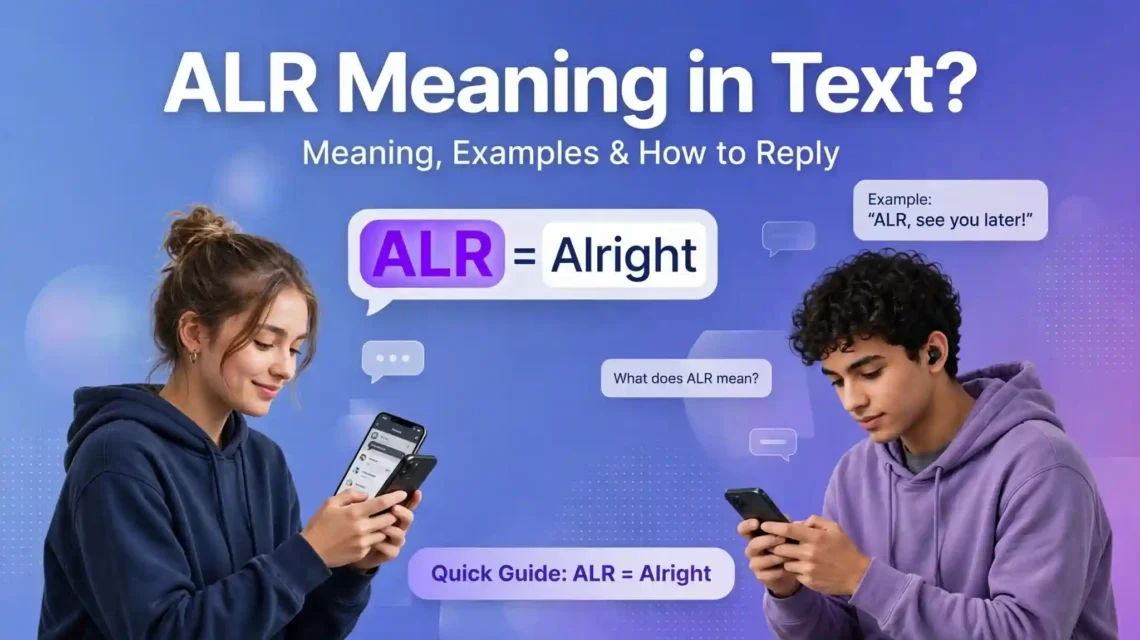
When it comes to texting, short forms can make conversations faster, but they can also create confusion. ALR meaning in text usually refers to “alright” or “all right.” People use this abbreviation in casual chats, social media messages, comments, and online conversations. Depending on the situation, ALR can show agreement, acceptance, acknowledgment, or a simple response to something someone said.
Understanding the tone behind ALR matters just as much as knowing its basic definition. A short “alr” can sound friendly, neutral, impatient, or even dismissive depending on the conversation. In this guide, you will learn what ALR means, where people use it, how to understand its tone, examples of real texting situations, and natural ways to reply.
What Does ALR Mean in Text?
ALR is a casual texting abbreviation that most commonly means “alright” or “all right.” It usually communicates agreement, acknowledgment, acceptance, or confirmation in everyday digital conversations.
The abbreviation removes several letters from the longer word while keeping its basic meaning. Like many texting shortcuts, it works best in informal communication rather than formal writing.
For example:
- “Alr, I’ll see you later.” = “Alright, I’ll see you later.”
- “Alr, sounds good.” = “Alright, sounds good.”
- “Alr then.” = “Alright then.”
- “Alr, no problem.” = “Alright, no problem.”
Is ALR Short for Alright?
Yes, in most texting situations, ALR is simply a shortened form of “alright.” It can also represent “all right,” since both forms commonly express agreement or acknowledgment.
There is no complicated hidden meaning in most casual messages. The sender often chooses ALR because it is quick to type.
The difference between alr, alright, okay, and ok often comes from personal texting style. Some people naturally use abbreviations, while others prefer complete words.
Consider these examples:
- “Alr” — casual and brief
- “Alright” — casual but more complete
- “Okay” — neutral and clear
- “Sure” — often shows agreement
- “K” — very brief and sometimes perceived as cold
The surrounding conversation gives the strongest clue about the sender’s intended tone.
ALR Meaning in Text Messages and Chats
In text messages, ALR usually works as a quick acknowledgment. It tells the other person that the sender has received, understood, or accepted what they said without adding much detail.
Texting encourages speed and convenience. People often shorten common words because typing a few characters feels easier than writing a full sentence.
Common uses include:
- Agreeing with someone
- “Alr, we can go at 7.”
- Accepting a request
- “Alr, I’ll send it tonight.”
- Acknowledging information
- “Alr, thanks for letting me know.”
- Ending a conversation
- “Alr, talk to you tomorrow.”
- Showing reluctant acceptance
- “Alr, if that’s what you want.”
- Moving to another topic
- “Alr, anyway, what are you doing?”
The word does not automatically indicate a particular emotion. You need to consider what came before it, punctuation, emojis, and the relationship between the people chatting.
ALR Meaning in Casual Conversations
ALR is especially common in relaxed conversations between friends, classmates, family members, gaming friends, and social media contacts. It generally signals that the person understands or agrees with something.
For instance:
Person A: “I’ll pick you up around eight.”
Person B: “Alr, see you then.”
Here, ALR has a friendly and cooperative meaning.
Another example:
Person A: “Don’t forget to bring your charger.”
Person B: “Alr.”
This response simply acknowledges the reminder.
Because ALR is informal, it may look out of place in professional communication. In an email to a manager, teacher, client, or customer, writing “alr” can appear too casual. A complete phrase such as “Okay, thank you” or “Understood” is usually clearer.
ALR Meaning in Text Depending on Context
The same abbreviation can carry different tones depending on the words around it. Context helps determine whether ALR sounds friendly, neutral, reluctant, annoyed, or dismissive.
This is important because text messages do not include vocal tone, facial expressions, or body language. A short reply can therefore be interpreted in several ways.
Friendly Use
A friendly ALR often appears with emojis, extra words, or a warm follow-up.
Examples:
- “Alr 😂 I’ll come.”
- “Alr, sounds fun!”
- “Alr haha, see you soon.”
- “Alr 😊 no worries.”
These messages generally feel relaxed because the sender adds signals that make the tone clearer.
Neutral Use
Sometimes ALR has no emotional meaning at all. The sender simply wants to acknowledge the message.
For example:
“I sent you the notes.”
“Alr, thanks.”
Here, the response is short but does not necessarily indicate annoyance.
Reluctant Use
ALR can also suggest that someone accepts something even though they may not be excited about it.
For example:
“We have to leave early tomorrow.”
“Alr, I guess.”
The phrase “I guess” changes the tone. It suggests acceptance without enthusiasm.
Annoyed or Dismissive Use
A very short response can sometimes feel cold, especially after disagreement.
For example:
“I already told you I’m busy.”
“Alr.”
In this setting, the abbreviation may sound like the person wants to end the discussion.
Still, it is important not to assume anger from one word alone. The broader conversation provides better evidence of the sender’s tone.
ALR Meaning in Text From a Girl or Guy
The abbreviation has the same basic dictionary meaning regardless of whether a girl or guy sends it. Gender does not create a separate standard definition for ALR.
People sometimes search for a special meaning when someone they like sends a short message. However, the abbreviation itself does not prove romantic interest, disinterest, attraction, or rejection.
Look at the complete conversation instead.
For example:
“Alr, goodnight :)”
This may sound warm because of the smiley face and the goodnight message.
Compare it with:
“Alr.”
This is more abrupt, but even that does not prove the sender is upset. They could be busy, distracted, tired, or simply accustomed to short replies.
When interpreting a message, consider:
- What did you say immediately before?
- Does the person normally use abbreviations?
- Did they add punctuation or emojis?
- Did they continue the conversation?
- Was the discussion positive, neutral, or tense?
- Do they usually send short messages?
These clues provide more useful information than the abbreviation alone.
Does ALR Mean They Are Mad?
Not necessarily. ALR does not automatically mean that someone is angry.
A single-word reply can feel cold because it contains little emotional information. But there are many harmless reasons for a short response.
Someone might write “alr” because:
- They are in a hurry.
- They are busy.
- They do not know what else to say.
- They are acknowledging your message.
- They prefer short texts.
- They want to move on to another subject.
If the conversation already contains disagreement, repeated short replies, or clearly negative language, the message may carry a more frustrated tone. Context matters more than the abbreviation.
How to Reply to ALR in Text
The best reply depends on what the sender means by ALR and what you want to communicate. You do not always need to answer with another abbreviation.
If the person is simply acknowledging something, you can continue naturally.
If You Want to Keep the Conversation Going
Try a question or follow-up:
- “Cool, what are you doing later?”
- “Sounds good! What time works for you?”
- “Nice, did you finish it?”
- “Okay, so what’s the plan?”
These replies give the other person something specific to answer.
If You Want to Confirm Plans
Use a direct response:
- “Perfect, see you at 7.”
- “Great, I’ll text you when I get there.”
- “Sounds good!”
- “Okay, see you then.”
This works well when ALR appears during planning.
If the Conversation Feels Tense
Avoid immediately assuming that the person is angry. A calm response can prevent unnecessary conflict.
You could say:
- “Everything okay?”
- “I hope I didn’t upset you.”
- “Let me know if you want to talk about it.”
- “No worries. We can discuss it later.”
Choose your response based on the wider conversation rather than one short word.
If You Want to End the Conversation
You can keep your answer brief:
- “Alright, talk later.”
- “Okay, have a good night.”
- “Sounds good. Take care.”
- “Cool, see you tomorrow.”
A short answer is perfectly reasonable when the conversation is naturally ending.
Examples of ALR in Texting
Examples make it easier to understand how the abbreviation changes with context. The following conversations show common ways people may use ALR in everyday digital communication.
Example 1: Making Plans
Alex: “Want to grab food at 6?”
Sam: “Alr, where?”
Here, ALR means agreement. The second question shows that Sam wants to continue planning.
Example 2: Accepting a Request
Mia: “Can you send me the file tonight?”
Noah: “Alr, I’ll send it after dinner.”
This use is straightforward. The sender accepts the request.
Example 3: Acknowledging Information
Liam: “The class starts at 9 tomorrow.”
Emma: “Alr, thanks.”
The sender simply acknowledges the information.
Example 4: Friendly Conversation
A: “You better not forget 😂”
B: “Alr 😂”
The repeated emoji makes the exchange playful.
ALR vs. OK, K, Alright, and Aight
ALR can look similar to several other texting expressions, but each may create a slightly different impression. Understanding these differences helps you choose the right response.
| Texting Term | Common Meaning | Typical Tone |
| ALR | Alright / all right | Casual |
| OK | Okay | Neutral |
| K | Okay | Very brief |
| Alright | Alright | Casual and clearer |
| Aight | Alright | Very casual/slang |
| Sure | Agreement | Friendly or neutral |
| Yep | Yes | Casual |
| Got it | I understand | Clear and direct |
These are not strict rules. Individual texting habits vary.
For example, one person may use “K” without any negative intention, while another person may use it only when annoyed. The sender’s normal communication style matters.
ALR generally sits in the middle. It is short and casual, but it does not automatically sound rude.
When Should You Use ALR?
ALR works best when the conversation is informal. It is useful when you already have a relaxed relationship with the person and both of you understand casual texting language.
You can use it in:
- Friend-to-friend conversations
- Casual group chats
- Gaming chats
- Social media messages
- Informal conversations
- Quick confirmations
- Everyday texting
You may want to avoid it in:
- Formal emails
- Job applications
- Business proposals
- Academic assignments
- Official notices
- Professional customer communication
- Important workplace messages
For example, sending “Alr, thanks” to a close friend is normal. Sending “Alr, thanks” to a potential employer may look unnecessarily informal.
Is ALR Proper English?
ALR is not generally considered standard formal English. It is a texting abbreviation used in informal digital communication.
The standard forms are “alright” and “all right.” ALR belongs to the same broader category as shortcuts such as “brb,” “idk,” “ttyl,” and “omw.”
That does not make ALR wrong in every situation. Language changes according to context. Informal online communication often favors speed and brevity.
The important distinction is between casual texting and formal writing.
Common Mistakes When Interpreting ALR
One common mistake is treating every short ALR reply as evidence of anger, boredom, or rejection. A brief message may simply reflect the sender’s normal texting habits.
Avoid these assumptions:
Mistake 1: Assuming ALR Is Always Rude
A short message can seem cold, but the sender may not intend it that way.
Mistake 2: Looking for a Hidden Romantic Meaning
ALR does not have a standard romantic meaning. You need to examine the complete conversation.
Mistake 3: Ignoring Punctuation
Compare:
- “Alr!”
- “Alr 😊”
- “Alr.”
- “alr”
These can create different impressions, although punctuation and capitalization are not universal emotional signals.
Mistake 4: Ignoring the Previous Message
The sentence before ALR often explains its purpose.
If someone says, “I’ll be there at 8,” and you reply “alr,” your message is likely simple acknowledgment.
If someone says, “I’m sorry, but I cannot come,” and you reply “alr,” the same word may carry more emotional weight depending on the relationship.
Mistake 5: Using It Everywhere
An abbreviation that works with friends may not work in professional communication. Match your language to the audience.
Tips for Understanding Texting Abbreviations
Learning abbreviations is useful, but context should always come first. Digital language changes quickly, and the same expression can carry different meanings across communities.
When you see an unfamiliar abbreviation:
- Read the whole message.
- Check the messages before it.
- Consider the relationship.
- Look for emojis and punctuation.
- Notice whether the person normally uses slang.
- Avoid assuming negative emotions too quickly.
- Ask for clarification if the message affects an important decision.
This approach works for ALR and many other texting shortcuts.
It is also helpful to remember that texting style varies by age, platform, friend group, region, and personal preference. Someone who uses many abbreviations may send “alr” without giving it any special emotional meaning.
Frequently Asked Questions About ALR
What is the most common ALR meaning in text?
The most common alr meaning in text is “alright” or “all right.” People generally use it as a quick way to show agreement, acknowledgment, acceptance, or understanding during casual conversations.
Does ALR mean okay?
Yes. In many conversations, ALR can function much like “okay.” For example, “Alr, I’ll do it” can mean “Okay, I’ll do it.” The exact tone depends on the surrounding conversation.
Is ALR slang?
ALR is best described as an informal texting abbreviation. It is common in casual digital communication but is not normally used in formal writing.
What does ALR mean from a girl?
The basic alr meaning in text does not change based on the sender’s gender. It generally means “alright” or “all right.” Any additional emotional or romantic meaning must come from the wider conversation.
What does ALR mean from a guy?
When a guy sends ALR, it usually has the same basic meaning: “alright” or “all right.” Context, punctuation, emojis, and the rest of the conversation help determine the intended tone.
How should I reply when someone says ALR?
You can reply naturally based on the situation. Try “Sounds good,” “Okay,” “Perfect,” or a follow-up question if you want to continue talking. If the conversation feels tense, ask whether everything is okay instead of assuming the sender is upset.
Conclusion
Understanding alr meaning in text is simple once you look at the context. In most casual conversations, ALR is a shortened form of “alright” or “all right.” People use it to agree, acknowledge information, accept a request, confirm plans, or close a conversation.
The tone can change depending on the message around it. “Alr 😊” may feel friendly, while “Alr.” during an argument may seem more distant. Still, ALR alone does not prove that someone is angry, bored, annoyed, or romantically interested.