
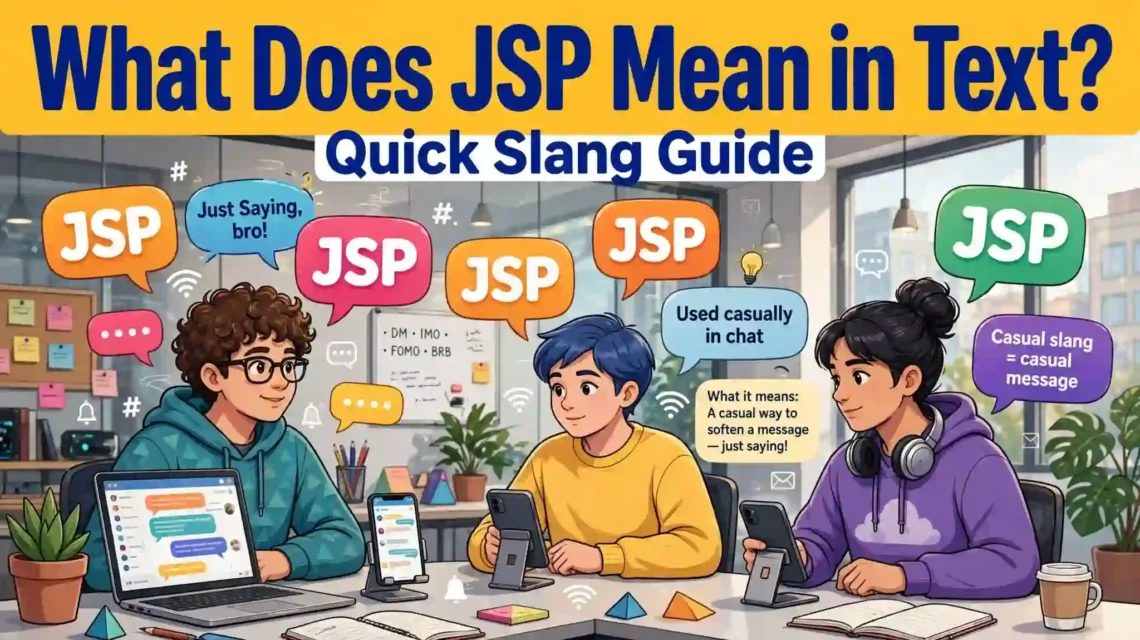
When it comes to online conversations, short forms help people send messages faster. You may see JSP meaning in text message, social media comment, or private chat and wonder what it means. The meaning can change with the topic and the people involved.
In casual texting, JSP may stand for “Just Saying, Though” in some conversations, but this is not a widely established or universal meaning. It can also be a personal abbreviation, a typo, or a reference to something outside texting. Context plays an important role in understanding it.
What Does JSP Meaning in Text?
The meaning of JSP meaning in text depends on the conversation. Unlike common abbreviations such as LOL or BRB, JSP does not have one widely accepted meaning in everyday texting. Some people may use it as a personal shorthand.
You should not assume that every person uses the same definition. A message from a friend may use JSP differently from a comment on a website or a discussion about technology.
Here are a few things to consider:
- The topic: A casual chat may use a different meaning from a technical discussion.
- The sentence: Words around JSP can help explain the writer’s intent.
- The sender: Friends may create their own abbreviations.
- The platform: A gaming chat, work message, or social media post may use different terms.
Is JSP a Common Texting Abbreviation?
JSP is not as common or clear as popular texting terms such as TBH, IMO, or IDK. Many people may not recognize it without extra context.
Some users may give it a personal meaning within a group chat. Others may use it as an abbreviation for a name, phrase, or technical term. This makes it difficult to assign one definition to every message.
For example:
- “JSP, that movie was great.”
- “I saw JSP in the group chat. What does it mean?”
- “Can you explain JSP in this message?”
Why Do People Use Short Forms Like JSP meaning in text?
People use abbreviations to make digital conversations quicker. A short form can save time when someone sends several messages in a busy chat.
Common reasons include:
- Saving time: Short forms reduce typing.
- Casual communication: Friends often use informal language.
- Personal habits: Some people create their own shortcuts.
- Group language: A group may share abbreviations that outsiders do not know.
- Character limits: Short messages can be useful on platforms with limited space.
Possible Meanings of JSP meaning in Text
There is no single standard texting definition for JSP. Its meaning may depend on the writer, platform, and subject of the conversation.
One possible interpretation is “Just Saying, Though.” However, you should treat this as an informal or context-specific use rather than a confirmed universal definition.
JSP as “Just Saying, Though”
Some people may use JSP to express an opinion or add a casual comment. In this use, the letters may represent “Just Saying, Though.”
The phrase can make a statement sound informal. It may also suggest that the writer is sharing an opinion without trying to start an argument.
For example:
- “That outfit looks better in blue, JSP.”
- “You should try the new restaurant, JSP.”
- “The first movie was much better, JSP.”
JSP meaning in text as a Personal or Group Abbreviation
A friend group may create its own short forms. These terms can make sense to members but confuse people outside the group.
For instance, a group may use JSP as initials for a shared joke, a person’s name, or a phrase they repeat often. The abbreviation may have no recognized meaning elsewhere.
Look at the conversation before and after the letters. If the sender uses JSP several times, you may notice a pattern. You can also ask them to explain it.
JSP in Technology and Computing
JSP has a well-known meaning in web development. It stands for JavaServer Pages, a technology used to create dynamic web content with Java.
Developers may use the term when discussing websites, server-side programming, or older Java web applications.
For example:
- “This project still uses JSP pages.”
- “We need to update the JSP file.”
- “The developer is working on a JSP application.”
In these examples, JSP is a technical term. It does not function as casual texting slang.
How to Understand JSP meaning in text in Different Conversations
The easiest way to understand an unfamiliar abbreviation is to read the full message. The topic often gives you a stronger clue than the letters themselves.
A casual message, a work conversation, and a programming discussion may use the same abbreviation in different ways. Do not rely on one definition without checking the situation.
JSP in Text Messages
A text message between friends usually contains casual language. The sender may use an abbreviation to share an opinion, make a joke, or save time.
Consider this example:
Person A: “I think we should order pizza tonight.”
Person B: “The burger place is better, JSP.”
The second person may be adding a casual opinion. If they intend JSP to mean “Just Saying, Though,” the phrase works as an informal comment.
However, the meaning is not certain. If you do not understand it, ask a simple question.
JSP on Snapchat and Instagram
Social media users often mix abbreviations, emojis, and short phrases. JSP may appear in a caption, direct message, comment, or story reply.
For example:
- “That picture looks amazing, JSP.”
- “You should post more videos, JSP.”
- “I liked the old design better, JSP.”
A social media user may intend the abbreviation as a personal shorthand. Another user may use the same letters for a completely different reason.
Do not assume that JSP has a fixed meaning on Snapchat or Instagram. The platform alone cannot confirm what the sender means.
JSP in Gaming Chats
Gaming communities use many short forms to communicate during matches. Players often need to send quick messages while playing.
JSP might appear as a team-specific abbreviation, a username reference, or a phrase created by players. It is not a universal gaming term with one confirmed definition.
If you see it during a game, check the situation. The sender may be referring to a player, a strategy, or an inside joke.
JSP in Work or School Messages
A work or school conversation needs extra care. An abbreviation may refer to a project, file, subject, or technical term.
For example:
- “Please review the JSP page before Friday.”
- “Our assignment covers JSP technology.”
- “The team needs to fix the JSP component.”
Examples of JSP meaning in Text Conversations
Examples can help you understand how abbreviations work in real messages. The following conversations show possible contexts where JSP might appear.
Remember that these are illustrative examples. They do not prove that JSP has one standard meaning.
Casual Conversation Examples
Example 1
Alex: “I think the blue shoes look better.”
Sam: “The black ones are nicer, JSP.”
Sam may be using JSP as a personal shorthand for adding an opinion.
Example 2
Mia: “Should I watch this new series?”
Lena: “Yes, it has a great story, JSP.”
Lena may be sharing an extra thought in a casual way.
Example 3
Noah: “I want to visit the beach this weekend.”
Ethan: “A mountain trip sounds better, JSP.”
Ethan may be adding his own preference. The exact meaning still depends on how he uses the abbreviation.
Social Media Examples
Example 4
User 1: “I finally finished my room makeover!”
User 2: “The new setup looks amazing, JSP.”
The comment may contain a personal abbreviation used by the writer.
How to Reply When Someone Sends JSP
Your response should depend on the message. If you understand the intended meaning, reply naturally. If you do not, ask for clarification.
You do not need to use the same abbreviation in your answer. A clear response is better than copying a term you do not understand.
Ask What JSP Means
This is the safest option when the context does not explain the abbreviation.
You can reply with:
- “What does JSP mean here?”
- “Can you explain that abbreviation?”
- “I’m not familiar with JSP. What are you saying?”
- “Do you mean something specific by JSP?”
- “Could you clarify that for me?”
These replies sound friendly and direct. They also avoid making an incorrect assumption.
Respond to the Message Instead
If the rest of the sentence makes the sender’s point clear, you can answer the main idea.
For example:
Friend: “The blue dress looks better, JSP.”
You could reply:
- “I was thinking the same thing!”
- “Thanks for your opinion.”
- “I’ll try the blue one.”
- “I like that choice too.”
- “Good suggestion!”
This approach works when the abbreviation does not affect the main message.
Reply in a Work or Study Conversation
If someone uses JSP in a technical discussion, respond to the subject rather than treating it as slang.
Possible replies include:
- “Are you referring to JavaServer Pages?”
- “Which JSP file should I review?”
- “Can you share the project details?”
- “Do you mean the JSP technology used in Java?”
- “I’ll check the page and get back to you.”
A clear question can help you understand the task and avoid errors.
Assuming It Has One Fixed Meaning
The biggest mistake is treating JSP as a universal texting term. It does not have one widely accepted meaning in everyday chat.
A friend may use it as a personal abbreviation. A developer may use it to discuss JavaServer Pages. A student may use it as a course or project reference.
Always check the context.
Using It Without Explaining It
If your audience does not know the abbreviation, your message may confuse them.
This matters in group chats, work messages, and conversations with new people. Write the full phrase when clarity matters.
For example, instead of using an unfamiliar abbreviation, say:
“I’m just sharing my opinion.”
A clear sentence helps everyone understand your point.
Confusing Slang With Technical Terms
JSP has a recognized technical meaning in web development. A person discussing Java may not be talking about texting slang at all.
Check the subject before deciding what the letters mean. Words such as “code,” “server,” “page,” and “developer” often point toward the technical meaning.
Copying Abbreviations Without Knowing Them
You may see an abbreviation in a comment and feel tempted to use it. Avoid copying it until you understand what it means.
An unfamiliar short form can make your message unclear. It may also create an awkward situation if you use it incorrectly.
Tips for Understanding Unfamiliar Texting Abbreviations
Digital language changes over time. People create new expressions, adapt old ones, and use the same letters in different ways.
You can understand unfamiliar abbreviations more easily by following a few simple steps.
Read the Full Conversation
Do not focus on the abbreviation alone. Read the messages before and after it.
The conversation may reveal whether the sender is joking, sharing an opinion, discussing a project, or asking a question.
Consider the Sender
Think about who sent the message. A close friend may use a private abbreviation. A colleague may use a technical term. A gaming partner may use community language.
The sender’s usual writing style can also help.
Check the Topic
The topic provides useful clues.
- A discussion about websites may involve technical terms.
- A conversation about clothes may involve opinions or preferences.
- A gaming chat may contain team-specific shorthand.
- A school message may refer to an assignment or subject
Ask for Clarification
There is nothing wrong with asking someone what an abbreviation means.
A simple question can save time and prevent confusion. Most people will explain the term if you ask politely.
Avoid Guessing in Important Messages
Do not guess when a message involves work, school, money, or instructions. Ask the sender to explain the abbreviation before you take action.
Clear communication matters more than replying quickly.
Frequently Asked Questions
1. What does JSP mean in text?
JSP does not have one widely accepted meaning in everyday texting. Some people may use it as shorthand for “Just Saying, Though,” while others may use it as a personal abbreviation. The surrounding conversation helps reveal the intended meaning.
2. Does JSP mean “Just Saying, Though”?
Some users may use JSP to represent “Just Saying, Though.” This is an informal, context-specific interpretation rather than a universal texting definition. Ask the sender if you are unsure.
3. What does JSP mean on Snapchat?
JSP does not have a confirmed, universal meaning on Snapchat. A user may use it as a personal abbreviation in a story reply or direct message. Read the full message before deciding what the sender means.
4. Is JSP a slang word?
JSP is an abbreviation, not a standard slang word with one fixed definition. Its meaning depends on the context. It can also refer to JavaServer Pages in web development.
5. How should I reply when someone texts JSP?
Ask what the sender means if the abbreviation is unclear. You can say, “What does JSP mean here?” If the rest of the message makes sense, respond to the main point instead.
6. Does JSP have a meaning in programming?
Yes. In web development, JSP stands for JavaServer Pages. It is a Java-based technology used to create dynamic web content. This meaning is different from informal texting use.
Conclusion:
JSP meaning in text can be confusing because it does not have one widely accepted meaning in everyday texting. Some people may use it to mean “Just Saying, Though,” while others may create their own abbreviation. In technology, it has a separate and established meaning: JavaServer Pages.
The best way to understand jsp mean in text is to look at the full conversation. Pay attention to the topic, the sender, and the words around the abbreviation. A casual chat may use personal shorthand, while a work or programming message may refer to a technical term.