
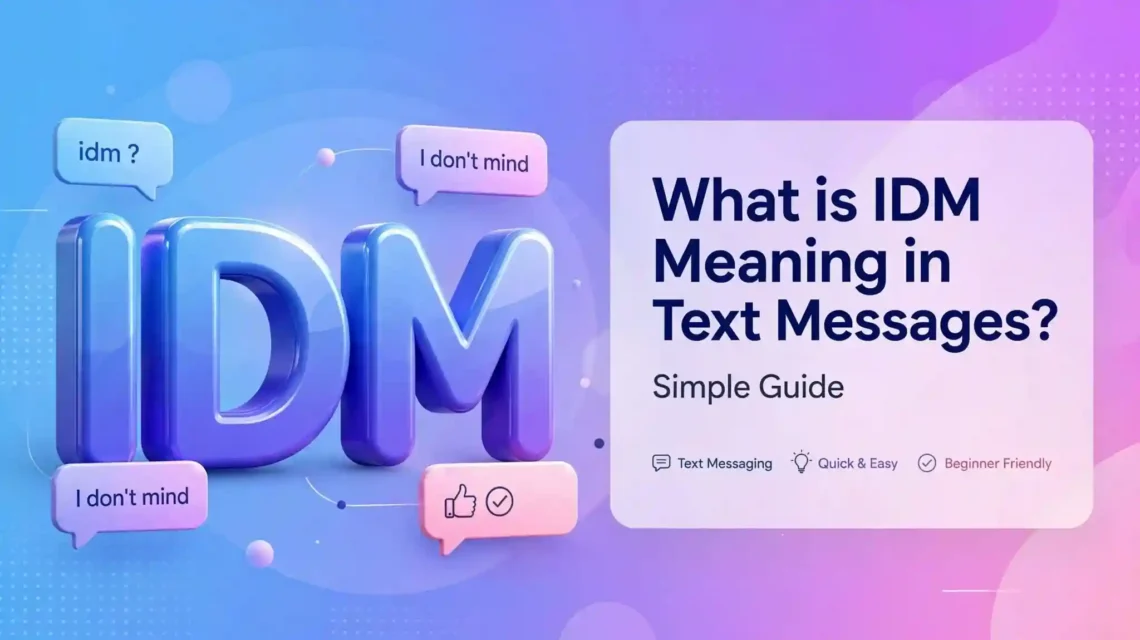
When it comes to texting and online chats, short forms can make conversations faster, but they can also create confusion. One example is IDM meaning in text, which can change slightly depending on the conversation. In most casual messages, “IDM” means “I Don’t Mind.” People use it to show that they are comfortable with a choice, option, or situation.
For example, someone may text, “Where should we eat?” and receive “IDM.” This usually means the person has no strong preference. They are happy to let the other person decide. However, abbreviations can have other meanings in different settings, so context matters.
What Is IDM Meaning in Text?
In everyday texting, IDM usually stands for “I Don’t Mind.” It is a casual abbreviation that tells another person that you have no objection to something. The phrase often communicates flexibility or a lack of preference.
For instance:
“Do you want pizza or burgers?”
“IDM.”
The second person is saying that either option is fine.
The abbreviation is especially common in informal conversations. You may see it in text messages, social media comments, group chats, gaming chats, and direct messages.
What Does “I Don’t Mind” Actually Mean?
“I Don’t Mind” means that something does not bother you or that you do not have a strong preference.
It can communicate several related ideas:
- Either choice is fine.
- I am okay with that.
- I have no objection.
- You can choose.
- It does not matter much to me.
- I am comfortable with the situation.
The exact meaning depends on the question and the tone of the conversation.
For example, if someone asks:
“Can we meet at 6 instead of 5?”
A reply of “IDM” means the person is okay with the change.
If someone asks:
“Which movie should we watch?”
“IDM” may mean the person does not care which movie you choose.
Therefore, the abbreviation usually expresses acceptance rather than enthusiasm. It does not necessarily mean that the person strongly likes the idea.
IDM Meaning in Texting and Online Chats
The common IDM meaning in texting is “I Don’t Mind,” especially when people discuss plans, choices, preferences, or small changes.
The abbreviation works because texting often favors short and efficient language. Instead of typing the complete phrase, users may write three letters.
You might see messages such as:
- “IDM where we go.”
- “IDM, you choose.”
- “IDM if we leave early.”
- “IDM either way.”
- “IDM what time.”
- “IDM, sounds good.”
These messages generally show flexibility.
Why Do People Use IDM?
People use short forms for several reasons. First, abbreviations save time. Typing “I don’t mind” takes longer than typing “IDM.”
Second, informal conversations do not always require complete sentences. Friends often understand abbreviations without needing extra explanation.
Third, texting culture has developed many commonly recognized shortcuts. Words such as “LOL,” “BRB,” “TBH,” and “IDK” have become familiar to many internet users.
IDM fits this same pattern.
It is most useful when the meaning is already clear from the conversation. If the topic is serious or professional, writing the complete phrase is usually safer.
How Is IDM Used in a Text Message?
The meaning becomes clearer when you look at examples. In most cases, IDM appears as a short response to a question about preferences or plans.
Example 1: Choosing a Restaurant
Person A: “Do you want Chinese food or pizza?”
Person B: “IDM.”
Here, Person B does not have a preference. Person A can choose.
Example 2: Changing the Meeting Time
Person A: “Would 7 PM work instead?”
Person B: “IDM.”
The response means the person is okay with the new time.
Example 3: Choosing a Movie
Person A: “Should we watch a comedy or an action movie?”
Person B: “IDM, you pick.”
This makes the meaning even clearer. The person is giving the other person freedom to decide.
Example 4: Making Weekend Plans
Person A: “Want to go Saturday or Sunday?”
Person B: “IDM. Either day works.”
In this case, IDM communicates flexibility.
Example 5: Group Chat
Friend 1: “Are we meeting at the mall or the café?”
Friend 2: “IDM.”
Friend 3: “Let’s do the café.”
Here, Friend 2 has no strong preference, so another person can make the final choice.
These examples show why context matters. IDM rarely provides a detailed answer by itself. Instead, it tells the other person that the sender is comfortable with the available options.
IDM Meaning in Text: Positive, Neutral, or Negative?
A common question is whether IDM sounds positive or negative. Usually, it is neutral.
When someone says “I Don’t Mind,” they normally mean that they accept the situation. They are not necessarily saying that they love the idea.
Consider this example:
“Do you want to watch this movie?”
If someone answers:
“IDM.”
They may be happy to watch it, but they may also simply be willing to go along with your choice.
The tone can change depending on punctuation and surrounding words.
Neutral Use
“IDM, whatever works.”
This sounds relaxed and flexible.
Friendly Use
“IDM 😊 you choose!”
This sounds warm and cooperative.
Short or Distant Use
“IDM.”
A one-word response can sometimes feel less enthusiastic. The sender may simply not care about the choice.
However, you should not automatically assume that a short IDM response means someone is annoyed. Text messages do not always show emotion clearly.
IDM Meaning in Text: Common Situations
IDM appears in many casual situations. Understanding these situations makes the abbreviation easier to recognize.
Making Plans
People often use IDM when deciding where or when to meet.
“Do you want to meet at 4 or 5?”
“IDM.”
The sender is comfortable with either time.
Food Choices
Food is another common situation.
“Should we get burgers or tacos?”
“IDM.”
The person does not have a strong preference.
Entertainment
People may use the abbreviation when choosing a movie, show, game, or music.
“Want to play Minecraft or Fortnite?”
“IDM.”
This means either choice is acceptable.
Travel Decisions
Friends planning a trip may use IDM when discussing smaller details.
“Window seat or aisle?”
“IDM.”
The person does not care which seat they receive.
Everyday Requests
The abbreviation can also respond to minor changes.
“Is it okay if I call you later?”
“IDM.”
The person is saying that the change is acceptable.
These examples show that the expression works best when the sender is genuinely flexible.
Is IDM Appropriate for Professional Messages?
IDM is mainly an informal texting abbreviation. It can work in casual workplace chats if the people involved commonly use abbreviations.
However, it is usually better to write “I don’t mind” in formal communication.
For example, in an email, instead of:
“IDM if we move the meeting.”
A more professional version would be:
“I don’t mind if we move the meeting.”
In a formal setting, clarity is more important than saving a few characters.
Good Places to Use IDM
IDM is generally suitable for:
- Messages to friends
- Family group chats
- Casual social media conversations
- Informal gaming chats
- Relaxed conversations with people you know well
Places to Avoid IDM
Consider avoiding it in:
- Formal business emails
- Job applications
- Academic writing
- Official documents
- Customer-service messages
- Important professional communication
The issue is not that IDM is incorrect. The issue is that informal abbreviations can look too casual in formal writing.
How to Reply When Someone Says IDM
If someone sends you IDM, your response depends on the situation.
If you asked them to choose between two options, you can simply make the choice yourself.
Example:
“Pizza or burgers?”
“IDM.”
You can reply:
“Okay, let’s get pizza.”
If you need more information, ask a follow-up question.
“IDM? So either one works for you?”
This can be useful when the decision is important.
You can also respond with:
- “Okay, I’ll choose.”
- “Sounds good.”
- “Either works for me too.”
- “Cool, let’s go with that.”
- “Perfect, I’ll decide.”
If the conversation is casual, you usually do not need a complicated response.
Common Mistakes When Using IDM
People sometimes misunderstand or misuse abbreviations because they focus on the letters instead of the context.
Mistake 1: Assuming IDM Means “I Like It”
IDM does not necessarily mean strong approval. It usually means the person does not object.
For example:
“Do you want to go at 8?”
“IDM.”
This means 8 is acceptable. It does not necessarily mean 8 is the person’s preferred time.
Mistake 2: Confusing IDM With IDK
As discussed earlier, IDK means “I Don’t Know.” IDM means “I Don’t Mind.”
These expressions answer different questions.
Mistake 3: Using IDM in Every Situation
An abbreviation is not always the clearest response. If someone asks a serious question, “IDM” may appear careless.
Mistake 4: Ignoring Tone
A bare abbreviation can sometimes seem cold. Adding a few words can make your message friendlier.
For example:
“IDM, whatever works for you!”
sounds more welcoming than:
“IDM.”
Mistake 5: Forgetting the Audience
Friends may understand IDM instantly. A new client or older relative may not.
When you are unsure whether the other person knows the abbreviation, write the complete phrase.
The central idea remains the same: the person has no strong objection or preference.
Tips for Using IDM Naturally
If you want to use the abbreviation correctly, keep a few simple rules in mind.
Use it when you genuinely have no preference. If you strongly prefer pizza, do not say IDM when asked about pizza or burgers. State your preference.
Add context when needed. “IDM, you choose” is clearer than a bare abbreviation.
Match the tone of the conversation. Casual chats are the best place for abbreviations.
Consider your audience. Not everyone knows every texting shortcut.
Avoid it when clarity matters. In formal or important communication, use the complete phrase.
These habits help you sound natural while avoiding misunderstandings.
Final Thoughts on IDM Meaning in Text
Understanding IDM meaning in text is simple once you know the context. In most casual conversations, IDM stands for “I Don’t Mind.” People use it when they have no strong preference or when they are comfortable with another person’s choice.
For example, if a friend asks whether you prefer pizza or burgers and you reply “IDM,” you are telling them that either option works. The expression can also appear when discussing meeting times, movies, travel plans, activities, and other everyday decisions.
Frequently Asked Questions
What is IDM meaning in text?
In casual texting, IDM usually means “I Don’t Mind.” It tells the other person that you have no strong preference or objection. For example, “Pizza or pasta?” followed by “IDM” means either choice is acceptable.
Does IDM mean “I Don’t Mind” or “I Don’t Care”?
IDM normally means “I Don’t Mind.” It can sometimes communicate a similar idea to “I Don’t Care,” but the tone is often softer. “I Don’t Mind” usually sounds more accepting and polite.
Is IDM the same as IDK?
No. IDM means “I Don’t Mind,” while IDK means “I Don’t Know.” IDM usually expresses flexibility, whereas IDK expresses uncertainty or a lack of knowledge.
Can I use IDM in a professional email?
You can, but it is usually better to write “I don’t mind” in a professional email. The full phrase sounds clearer and more formal, especially when communicating with clients, managers, teachers, or unfamiliar contacts.
Is IDM rude in texting?
IDM is not normally rude. However, a very short reply can sometimes sound distant depending on the conversation. Adding words such as “IDM, you choose” can make the message sound more friendly.
What should I reply when someone texts IDM?
If someone says IDM after you offer several choices, you can make the decision yourself. Replies such as “Okay, let’s go with pizza” or “Sounds good, I’ll choose” work naturally in casual conversations.